Academics

Economics 2007-2008

Check out the Economics web site.

Economics News Archive


Geologist finds valuable treasure in French Guyana

Votto Vines Importing wins annual Business Plan Competition

Union students are finalists in business competition

Admissions Open House set for Monday

College donates house and labor to Habitat for Humanity

More News & Events

Overview

The economics curriculum at Union is designed to provide students with the intellectual tools they need to understand and critically evaluate the many economic issues they confront on a daily basis. Some of these issues, such as the way markets work (or fail to work), taxes, and government regulations, involve individuals or companies, while others involve major national and international questions, such as the causes of recession, managing the global environment, the merits of free trade, or understanding the rise and fall of nations as economic powers.

In each course, from Introductory Economics through the Senior Thesis, students are in close contact with faculty who stand ready to help them tailor their study to their interests and career goals. To that end, there are three different ways to major in economics at Union, as well as the option of minoring in economics. The majors are Economics — the standard major; Managerial Economics — for those planning careers in management; and Interdisciplinary — economics combined with any other Union major. The Quantitative Economics Track within the standard major is available for students strong in mathematics or those who have an interest in graduate school in economics.

Each major requires a core of economic theory and statistics courses, and a senior thesis. Managerial and Interdisciplinary Economics and Engineering majors as well as Quantitative Track students have several additional requirements. Beyond the require- ments, students are free to choose electives from a wide range of economics courses covering public finance, corpo- rate finance, game theory, labor, international trade and finance, environmental economics, econometrics, financial markets, efficiency and productivity, and more.

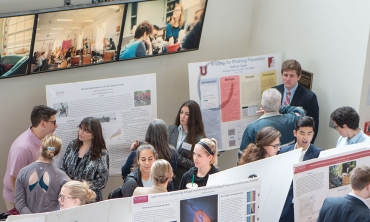
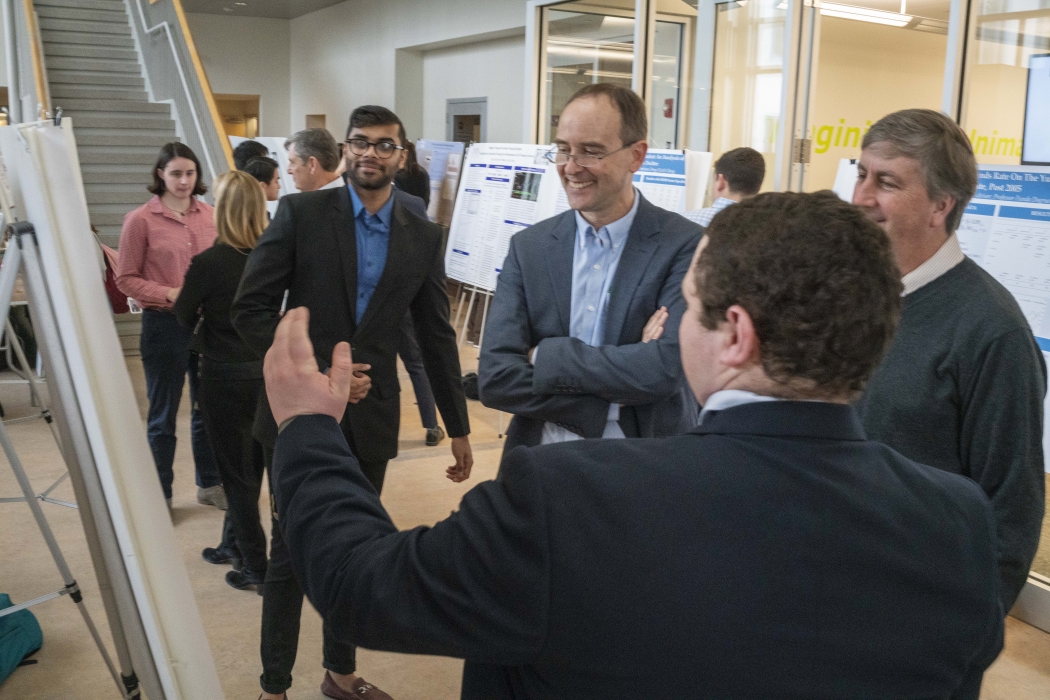
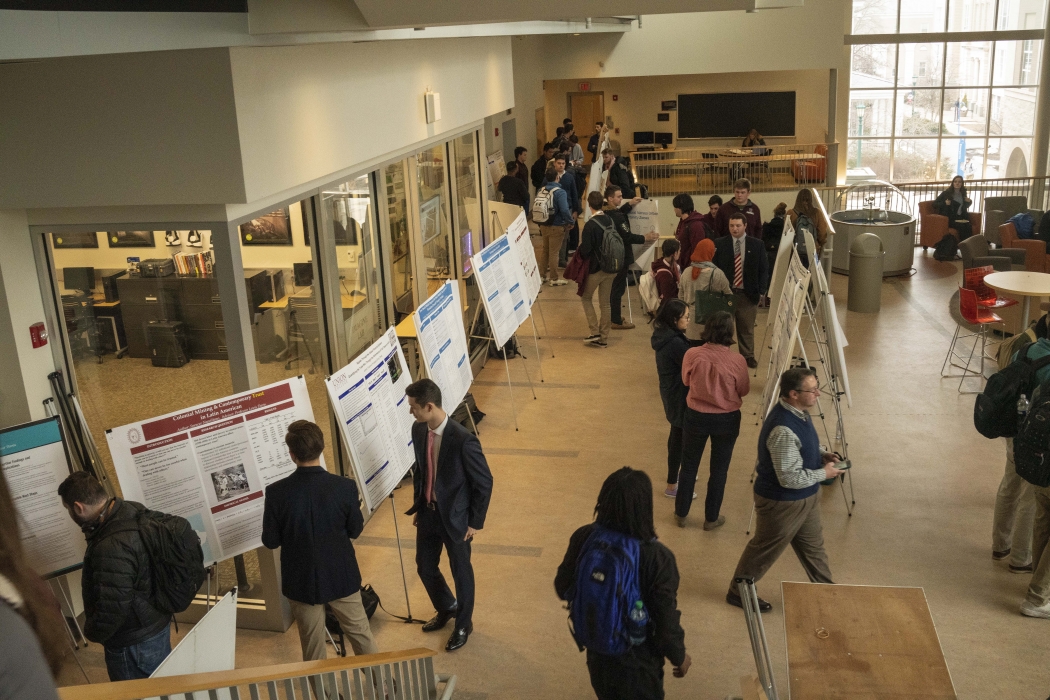
A very important part of the department’s curriculum is its emphasis on student research. Research papers are required in a number of the department’s courses, and all majors complete a senior thesis. The thesis represents a capstone of the student’s work at Union and offers each student the opportunity to explore a subject in depth, working individually with a faculty member over two terms. The thesis receives the same credit as two courses.

Unless a student receives advanced placement credit for economics taken in high school, or has taken economics at another college or university, the starting point for all of the department’s courses is Economics 101, a one-term introduction to the basic concepts of microeconomics and macroeconomics. Beyond Economics 101, students progress through lower level applied courses, intermediate theory courses, and upper level seminars and applied courses before undertaking the senior thesis.

If you have questions about our program, please phone the Economics Department at (518) 388-6200. You can also learn more from Union’s Web page at http://www.union.edu and the Economics Department’s Web page at http:// www.union.edu/PUBLIC/ECODEPT.

OPPORTUNITIES FOR MAJORS

Any of the ways of majoring in economics at Union is fully compatible with taking one of Union’s Terms Abroad. — Students taking economics courses make use of the Statistical Laboratory located in the basement of the Social Sciences Building. — Students may qualify to participate in the department’s Senior Honors Program and may also earn a place in Omicron Delta Epsilon, the national economics honorary society. — Whether majors or not, students are invited to join the Economics Club at Union. The club sponsors social events, speakers on economic issues and economic careers, and leads the Junior Achievement program in Schenectady elementary schools each Spring. — Students who have taken a corporate finance course can apply to become portfolio managers of the Student Investment Fund, a portfolio of securities which is a part of the College endowment, approximately valued at $300,000. (Yes, it is real money.) — Students have an opportunity to work with department faculty on research projects during summers, and these collaborations occasionally lead to joint student-faculty publications. — Students can also receive credit for internships arranged by the department with both public and private sector sponsors.

THE FACULTY

Lewis S. Davis
Assistant Professor of Economics
Ph.D., University of North Carolina
Development economics, econometrics

Tomas Dvorak
Associate Professor of Economics
Ph.D., University of Maryland
International finance, macroeconomics, transition economics

Harold O. Fried
Professor of Economics
Ph.D., University of North Carolina
Efficiency measurement, international trade,
econometrics

James M. Kenney
Professor of Economics
Ph.D., Stanford University
Managerial economics, environmental economics

J. Douglass Klein
Professor of Economics
Ph.D., University of Wisconsin
Industrial organization, energy economics, efficiency measurement

Bradley Lewis
Professor of Economics
Ph.D., University of Chicago
Financial analysis, economic history

Therese A. McCarty
Professor of Economics
Ph.D., University of Michigan
Public finance, economics of education

Eshragh Motahar
Associate Professor of Economics
Ph.D., Johns Hopkins University
Macroeconomics, monetary economics, investment theory

Shelton S. Schmidt
Professor of Economics
Ph.D., University of Virginia
Industrial organization, econometrics, efficiency measurement

Stephen J. Schmidt
Associate Professor of Economics
Ph.D., Stanford University
Industrial organization, economics of education, economic history

Mehmet Fuat Sener
Associate Professor of Economics
Ph.D., University of Florida
International economics, growth
and development economics,
macroeconomics, labor

Younghwan Song
Assistant Professor of Economics
Ph.D., Columbia University
Labor economics and econometrics

Suthathip Yaisawarng
Professor of Economics
Ph.D., Southern Illinois University
Efficiency measurement, microeconomic
theory