Geology 2007-2008
Overview
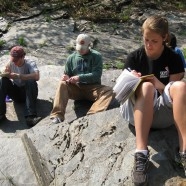
Geology is the science of the Earth, its physical makeup, its history, and how it works. Geology students make the whole Earth their field area for exploration, from the Arctic to Antarctic, from the Earth´s hot core to its restless, shifting crust and turbulent atmosphere and oceans. You are not confined by the walls of a classroom and laboratory bench when you study geology. In fact, you can´t do geology without touching the Earth, probing it with sensitive instruments, and looking at it with a keen eye. That´s why the geology student´s typical uniform is outdoor clothes and a good set of hiking boots.
When you choose geology, you don´t have to abandon your interest in other areas, including physics, chemistry, and biology. Geology is an open-ended discipline that can use people with expertise in many other fields. Geophysics, geochemistry, and paleontology are just three areas of geological specialization that require solid grounding in allied disciplines.
Our students gain a solid foundation in geology that enables them to be competitive in just about any part of the geosciences job market and in graduate or professional schools. They are educated in a liberal arts and engineering college that has traditionally been very strong in the sciences and is committed to graduating well-rounded people. We don´t try to train specialists at this level.
Geology includes not only study of Earth´s present and past, but the application of science to human society in recently important areas such as protection of the environment, searching for natural resources, protection from geologic hazards, and assisting with land use planning. When you choose geology, you´ve opened the door to a wide range of careers. Union geology graduates include some who have risen to high positions in business and government, including executives with major oil companies, directors of state geological surveys, and presidents of their own companies. Many of our students find quick employment at geological, engineering, and environmental consulting firms, state surveys, and government agencies, and most of the rest go on to graduate school at some of the top universities in the country.
Whenever possible, the Geology Department brings its students out into the field through class lab periods, extended field trips, and through faculty-student research projects that have recently included the Olympic Mountains of Washington, the Grand Canyon, the Russian far east, the Alps in France and Italy, the Gasp Peninsula of Quebec, the Andes Mountains of Peru and Ecuador, the Southern alps of New Zealand, and the Pyrenees in Spain.
Geology field trips are always exciting! In a recent trip to Romania, students hitched a ride on a Gondola in a ski resort to examine beautiful exposures to sedimentary rocks exposed at the top of a mountain in the center of the Carpathians. This trip followed a weeklong tour of the geology of Transylvania that included a look at Jurassic limestone at the base of Dracula´s Castle! Another trip, which is regularly scheduled, takes the Carbonate Sedimentology class to a remote island in the eastern Bahamas. Here, under the tropical sun, they examine fossil reefs, take sediment cores from lakes, and snorkel in lagoons.
The Faculty
Union´s geology professors are working geologists. As professional scientists, they are teachers who are always learning, and students work with them as colleagues. They, with their students, are explorers and detectives of our dynamic planet.
- John I. Garver (Director of Environmental Studies, Ph.D. University of Washington). Sedimentation and tectonics, fission-track dating.
- Kurt T. Hollocher (Chair, Ph.D. University of Massachusetts at Amherst). Petrology and geochemistry of rocks, geochemistry of natural waters.
- Donald T. Rodbell (Ph.D. University of Colorado). Glaciation and climate change.
- George H. Shaw (John and Jane Wold Professor of Geology; Ph.D. University of Washington). Geophysics, hydrology and geochemistry of karst, science and public policy.