Astronomy and Physics
Major, Minor
DEPARTMENT: PHYSICS & ASTRONOMY
About the Astronomy major
As a Union College astronomy major, you will search for extrasolar planets, study galaxy formation, model nuclear reactions and explore the origins of the universe.
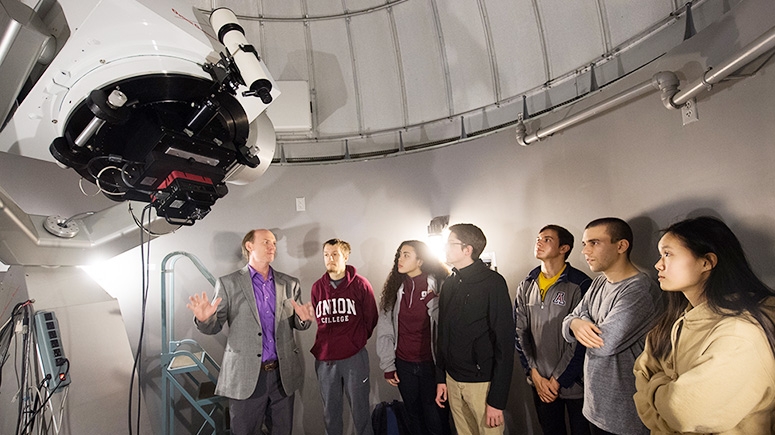
Students work with state-of-the-art facilities, including a 20-inch optical telescope with CCD cameras and spectrograph and a 7.5-foot radio telescope. Faculty research spans galaxy evolution, active galactic nuclei, star formation and stellar nucleosynthesis.
Independent research with faculty mentors is central to the program, supported by Department of Energy and National Science Foundation grants. Many students pursue summer research at Union, observatories or national laboratories and present their work at conferences or in co-authored journal articles.
Astronomy courses and requirements
-
Courses
- Loading...
-
Major
Loading...
-
Minor
Loading...
-
Interdepartmental major
Loading...
About the Physics major
As a Union physics major, you will study the fundamental laws governing force, matter, motion, energy, time and space. In small classes, you will explore modern physics through courses in relativity, electromagnetism, quantum mechanics, black holes and related topics that reshape how we understand the universe.
Faculty members—recipients of grants and awards from the National Science Foundation, NASA and other major agencies—teach all labs and mentor students using instrumentation comparable to that of much larger institutions.
Students also benefit from active chapters of the Society of Physics Students, Sigma Pi Sigma and Sigma Xi, as well as a departmental colloquium series highlighting advances in the field.
Physics courses and requirements
-
Courses
- Loading...
- Loading...
-
Major
Loading...
-
Minor
Loading...
-
Interdepartmental major
Loading...
About the Astrophysics minor
As a Union College astrophysics minor, you will apply the principles of physics to astronomical phenomena, gaining insight into the structure and history of the universe.
The minor includes an introductory course, The Solar System, and five electives in areas such as astrophysics, stellar evolution, galaxies, cosmology and observational or radio astronomy. Laboratory courses provide hands-on experience using the College’s 20-inch optical telescope, CCD cameras and spectrograph, as well as a 7.5-foot radio telescope.
-
Astrophysics requirements
Loading...
Careers after Union
Astronomy educator, Astronomical Society of the Pacific
Creative technologist, Primacy
Educator, Astronomical Society of the Pacific
Graduate student, University of Wisconsin-Madison
Creative technologist, Primacy
Fulbright researcher, Germany
Applications engineer, EBM–PAPST
Chamberlain Fellow, Berkeley National Lab
Design assistant, Newgrange Design
Electrical engineer, Advanced Energy Conversion
Implementation technology consultant, Paytronix Systems