Big hats come with big responsibilities, but also big rewards. Just ask Martiqua Post ’99.
She has a couple of pretty important jobs—jobs that require immense dedication to people and country—but she wouldn’t trade the happiness they bring her for anything. She loves being an aeronautics professor at the U.S. Air Force Academy and a deputy program manager at the federal Defense Advanced Research Projects Agency (DARPA).
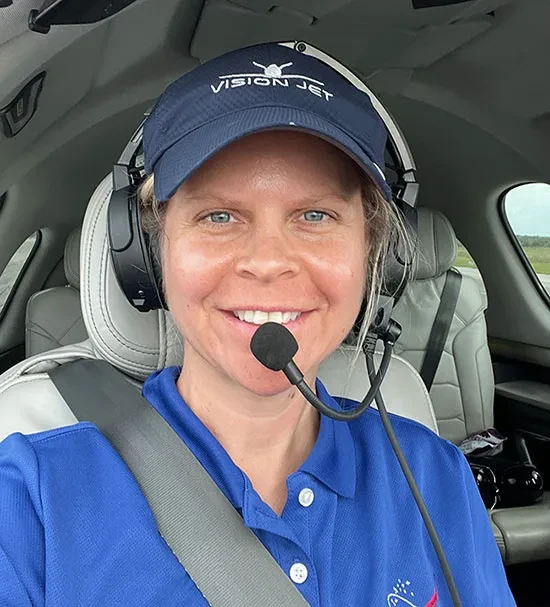
Post majored in mechanical engineering at Union and minored in math before earning a Ph.D. in aerospace and mechanical engineering from the University of Notre Dame.
“Early in life, I realized I had a gift for math, abstract objects, scientific reasoning and decision-making. I felt a responsibility to use my gifts and opportunities to make this world a better place,” she said. “This led me to engineering and, ultimately, aerospace—which has been filled with discovery, knowledge, conversation and innovation.”
She credits her mother, Charlotte, for inspiration.
“Her belief in the power of learning and her constant encouragement taught me not only to pursue an education but to embrace it as a lifelong journey,” Post said. “She planted the seeds of curiosity and resilience and nurtured my self-confidence.”
This is evident in Post’s career with DARPA, a Department of Defense agency that invests in new technologies to create new capabilities for national security. Here, driven by her curiosity and passion for discovery, she spends most of her time helping oversee the Control of Revolutionary Aircraft with Novel Effectors (CRANE) program.
“We’re building an X-plane to demonstrate active flow control technology,” she explained. “Since the Wright brothers, airplanes have relied on movable control surfaces like ailerons and rudders.
“CRANE’s X-65 uses compressed air blown over the wings to shape airflow, allowing the aircraft to fly without external moving parts. This capability could offer significant benefits to both military and civilian aviation.”
This sort of work pairs perfectly with her other big job—teaching aeronautics at the U.S. Air Force Academy.
“Aeronautics, a subset of aerospace engineering, involves the study and design of vehicles capable of operating within the atmosphere,” Post said. “All of my students will become Air Force officers ready to serve our nation, with a majority becoming pilots, unmanned aerial vehicle pilots or engineers.”
To better serve her students, in 2013, Post herself earned a private pilot’s license.
“It was inspiring to study and fly next to my students and for me to understand what they would be going through as officers in pilot training,” she said. “Becoming a pilot helped me connect better with my students and helped me as a professor by providing an alternate way to explain some concepts.”
“It also made me a more ‘legit’ aero prof!” Post added. “I love teaching. Working with motivated young people is inspiring. They are the future.”
This is especially true in fields with quickly evolving technology, like aerospace.
“We really need to ponder the societal impacts of our choices now to ensure a future filled with the freedoms we experience today and to create capabilities for future generations,” Post said. “To make that a reality, we need more educated, innovative engineers.”
“We need individuals motivated by the opportunities of the rapidly expanding capabilities in air and space, such as autonomous systems, machine learning, high-speed flight, very low earth orbit operations and space exploration,” she added. “I am really excited about the future!”
How did your time at Union inform your career path?
“My Union College education was a foundational investment in myself; the rigorous curriculum fed and fueled my passion for learning. One of my favorite mentors was mechanical engineering professor Ann Anderson. We conducted research on how turbulence affects heat transfer and together wrote my first journal paper. From her, I discovered the joy and benefit of independent research. Union also created opportunities to broaden my experiences, and broadened my world: I interned at Alcon Laboratories in Irvine, Calif., hosted by an alumnus. I worked on re-engineering the large machines used in cataract surgery and served alongside a quality engineer on the operations floor. My senior year, I spent a semester at the Czech Technical University in Prague. Looking back, I can see how each of these experiences shaped the path that led me to where I am today.”
—Martiqua Post ’99, U.S. Air Force Academy aeronautics professor & deputy program manager, Defense Advanced Research Projects Agency
