Carl George, professor emeritus of biological sciences whose wide-ranging curiosity forged connections across natural history, culture, art, architecture, classics and the ancient world, died Dec. 18 at the Schenectady Center following a brief illness. He was 95.
George joined Union in 1967 and over the next three decades, mentored generations of students. Whether lecturing in the classroom or taking his students on hikes, bird counts or other field research, George was an inspiring figure to those thirsty for knowledge.
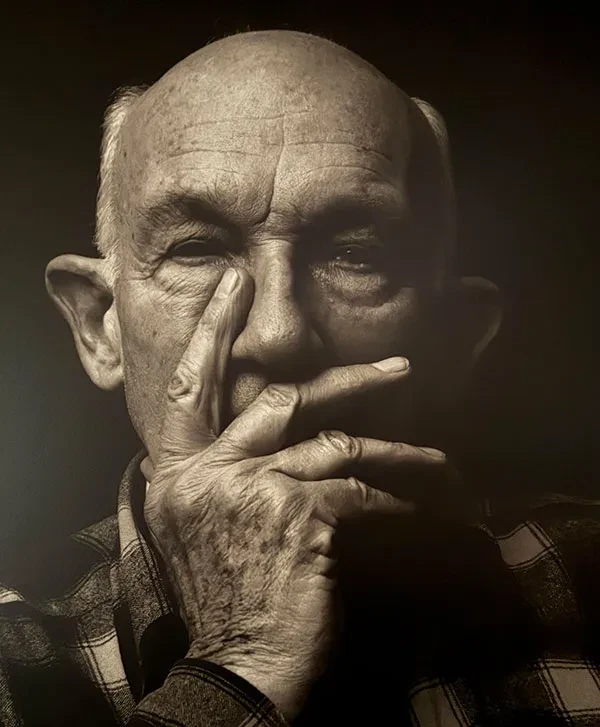
Carl George on campus (Photo by Barry Goldstein '73)
Captivated by natural design, George was co-creator, with Walter Hatke of Visual Arts, of a popular course, “The Illustrated Organism,” in which students are encouraged to produce exquisitely graphic and written analyses of plants and animals.
“He was the most creative teacher I’ve ever known,” said longtime friend Peter Tobiessen, professor emeritus of biological sciences. He joined Union in 1970, and his office was right next door to George’s, giving him a closeup of a myriad of George’s ideas, which ranged from the serious to the eccentric.
“Carl was born 100 years too late,” Tobiessen said. “He would have made a superb 19th century naturalist historian.”
One of George’s former biology students was the accomplished author Andrea Barrett ’74, a National Book Award winner in 1996 for fiction for “Ship Fever and Other Stories.” The recipient of a Guggenheim Fellowship and a MacArthur Fellowship, Barrett noted the profound impact George had on her life.
“Carl was a truly remarkable human being, a great teacher and a rare and dedicated mentor,” said Barrett, who routinely kept in touch with him for decades after graduating. “Much of what I did since leaving Union stemmed directly from his influence and example—his classes, absolutely, but also his work at the Isles of Shoals marine biology station, at Lake George, and elsewhere; his passion for biological illustration and older works of natural history; his engagement with art and language.
“He treated his students as if we could be exactly as brilliant and engaged and hard-working and curious as he was himself: a priceless gift, from a priceless person. Not just the gift of knowledge, but the understanding that we could keep learning throughout our lives, and perhaps share that with others.”
Though he retired in 1997, George remained very much involved in the life of the College.
“He was one of the first people to welcome me to campus, and he offered to show me around the natural areas in Schenectady,” said Kathleen LoGiudice, professor emerita of biological sciences, who joined Union in 2002. “One Saturday early in the fall term, he picked me up and showed me six or seven natural areas, many of which I was unlikely to have found by myself. We went to lunch and spent the entire day in the field.”
Widely known as a champion for the preservation of the Nott Memorial, the College’s architectural centerpiece, George also leaves a legacy as a community builder.
He retired along with his close friend and colleague, the late Twitty Styles, professor emeritus of biology, and together, they created UNITAS, an organization that supports groups and individuals who foster community and diversity on campus. Fittingly, they held their retirement ceremony in the Nott Memorial.
In his more than two decades of retirement, George was a fixture at campus events. A lifelong learner, he maintained an office in the former Emeritus Center above Old Chapel, using it as home base for his campus forays and the tours he led of the Nott Memorial. He carried a composition notebook at all times to record everything from lecture notes to bird sightings and filed them in chronological order on shelves in his office.
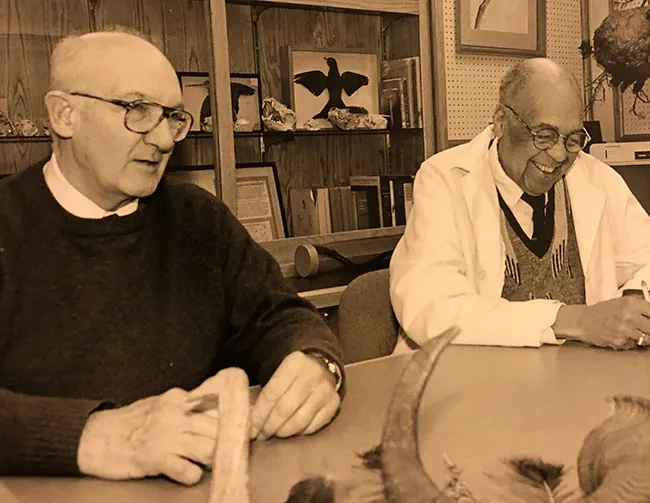
Carl George with his close friend and colleague, the late Twitty Styles, professor emeritus of biology. Together, they created UNITAS. an organization that supports groups and individuals who foster community and diversity on campus.
He was a frequent guest for UCALL (Union College Academy for Lifelong Learning), lecturing on the Nott Memorial and the College’s valuable collection of John James Audubon’s “Birds of America.” Union’s president, Eliphalet Nott, paid $1,000 in gold for an original four-volume set in 1844.
In his later years, when declining health limited his travel to campus, George was a frequent and welcome caller to staffers in the Office of Communications and Marketing. He had a ready supply of story ideas and a seemingly total recall of College history.
His lengthy list of accomplishments earned him the College’s Faculty Meritorious Award in 2009.
He was among a group who organized the creation of statues to commemorate the bond between abolitionist Harriet Tubman and William H. Seward, Class of 1820, secretary of state to Abraham Lincoln. The statues were dedicated at the Schenectady County Public Library in 2019.
George’s home, a geodesic dome on a wooded hillside in nearby Glenville, held an extensive collection of art and artifacts from his worldwide travels. The home featured a three-story tower from which he could observe the many birds in his area.
An ardent conservationist and consulting biologist, he advised a number of local governments on issues related to wetland conservation, land protection, agricultural use and solar farms.
In 2011, George stopped by then-President Stephen Ainlay’s office and asked him to go for a ride. The two got in George's car and drove a short distance from campus to St. David's Lane in Niskayuna.
There, George showed Ainlay a sprawling property that included a historic 2,400 square-foot Dutch replica home built by noted Adirondack conservationist Paul Schaefer in 1934 that was used for offices and meetings. A 3,900 square-foot addition contained additional offices, conference rooms and the Adirondack Research Library, which boasts the largest collection of material outside of the Adirondack Park, including rare books, maps, photographs, documents and the personal papers of some of the region's foremost conservationists.
"We can own this," said George, who lectured extensively on the Adirondacks.
That quick trip culminated in the opening in 2013 of the Kelly Adirondack Center, launching a new chapter in the College's rich and deep history with the Adirondacks.
He was founding editor and writer of An Adirondack Chronology.
He was a founding board member and advisor to Adirondack Wild: Friends of the Forest Preserve. He served as board chair of the largest Nature Conservancy chapter in the area, the Eastern New York Chapter. He was instrumental in launching an Adirondack chapter of the Nature Conservancy.
George earned a B.S from the University of Michigan and a Ph.D. from Harvard University. He had a fascination with domed buildings long before he arrived at Union. His previous teaching post at American University in Beirut had given him access to some of the most famous buildings in the ancient world: the Tomb of Agamemnon in Greece, the Pantheon in Rome and the Church of the Holy Sepulchre in Jerusalem. (He left Beirut during the Six Day War in June 1967 after arranging the evacuation of other Americans at the university.)
When he saw the building at the center of campus, he said, “Union felt like home.”
Once at Union, George became fascinated with the symbolism in Edward Tuckerman Potter’s design of the Nott. While teaching a first-year preceptorial, he found a connection between the building’s design and patterns found in nature, particularly the golden ratio, which describes the spiral arrangement of leaves and is echoed in the arches over the building’s windows. He also found connections with Plato’s works.
“This is the world of mathematics and numbers,” George said in a video about the building. “This is the world of Plato’s forms, and there at the very end is the good and the truth. And so, the Nott Memorial is transformed in this rather wonderfully geometric way into a message facing in all directions … the Nott becomes more than a monument to our great president, Eliphalet Nott. It becomes a monument to the academic purpose and our search for the good and the truth.”
Shortly after he became Union’s president in 1990, Roger Hull was introduced to George. He came to lobby the president to save the Nott, which had fallen into disrepair and was being considered for demolition by the board of trustees.
“I told him we would not take the Nott down, and it would be the second building on my watch,” Hull recalled. “When he asked ‘why second”? I said we had to first find a new home for the theater, then housed in the Nott. After securing the funds for the Yulman Theater, we turned to the Nott, which reopened on our bicentennial. Ever since then, Carl was my ‘Nott whisperer,’ regaling me with his theories of why the ceiling of the Nott was constructed as it was and what it meant. A kind and thoughtful man and a beloved professor, he will be missed.”
At his retirement gathering, George cited the 1995 renovation of the Nott as a high point of his years at Union.
“I had been a gadfly on the Nott Memorial for many years, and now, other than teaching students, it would be the Nott Memorial that I am most proud of in terms of my contribution to the College,” he said.
George's affection for Union extended to his philanthropy. He generously supported the Kelly Adirondack Center, Henle Dance Pavilion, Schaffer Library, Nott Memorial Restoration Fund and The Union Fund, among other initiatives. He created the Gail Wood George World Music and Dance Fund in memory of his late wife, and endowed a fund for UNITAS along with Styles. Prior to his passing, George arranged for two other funds to be established -- one for biology research and the other for dance.
Said LoGiudice, “Carl was the consummate teacher. He never stopped teaching and learning. He was fascinated by everything, especially the natural world, but also philosophy, geology, music, dance, history. He was truly a renaissance man, a gentleman naturalist. They don't make them like him anymore.”
Survivors include his wife, Christine Cameron ’79, who first met George as a student at Union. The couple married in 2011. George’s first wife, Gail, who passed away in 2008, was an energetic force in the Union community and a champion of dance, theater, music and women’s studies. Her legacy continues in the performing arts.
A memorial service is planned for sometime in the spring.