In February 1795, the state Board of Regents gathered in New York City to decide where a new college would be established: Albany or Schenectady.
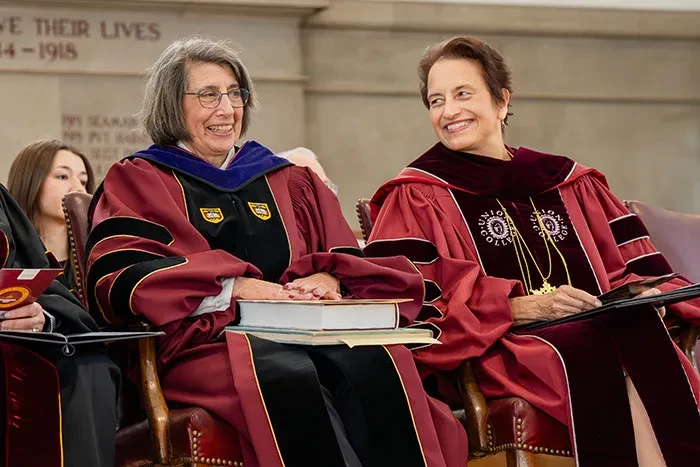
Founders Day speaker Judith G. Dein ’76, a federal magistrate judge, with President Elizabeth Kiss.
For years, proponents of both groups had waged a fierce battle in pushing its proposals. Albany was viewed as the favorite, but after the Schenectady group made some last-minute tweaks to its plans, the Regents voted convincingly to establish a college in Schenectady.
The charter, the first granted by the board, completed a 16-year process: the birth of Union College. The news touched off a spirited celebration that spilled into the frontier town’s streets.
On Thursday, the campus community gathered in Memorial Chapel to celebrate the 231st anniversary of that charter on Founders Day.
The featured speaker was Judith G. Dein ’76, a federal magistrate judge of the U.S. District Court for the District of Massachusetts who served as its chief magistrate judge from 2009-12. She was introduced by President Elizabeth Kiss, participating in her first Founders Day.
Dein reflected on the relevance of Union’s values since its founding to today’s world, where “truths which have been considered self-evident throughout my lifetime, ranging from the treatment of our fellow human beings to the foundation of our democracy being based on the existence of three co-equal branches of government, are constantly being challenged.”
As the first liberal arts college to offer engineering in 1845, Union holds a distinctive place in higher education. In introducing engineering, longtime president Eliphalet Nott said “students cannot thrive in the modern world, or be good citizens, if they do not venture beyond their major course of study.”
Dein said that belief carries forward today with the Templeton Institute, which promotes the integration of engineering and computer science and liberal arts to focus on academics as well as real-world challenges.
“Is a liberal arts education still relevant in today’s world?” Dein said. “After much pacing around my house, I keep coming back to my belief that Union’s principles, and the education Union provides, are more important to each of us individually, and to us as a democratic society, than ever before. And these principles are worth supporting and fighting for.”
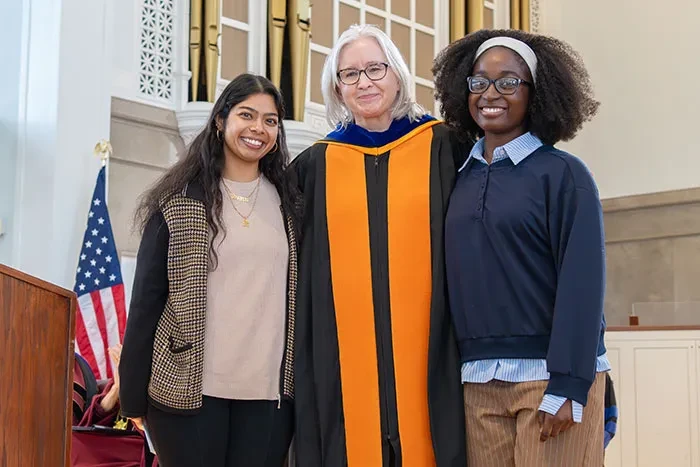
Michele Angrist, the Stephen J. and Diane K. Ciesinski Dean of the Faculty and Vice President for Academic Affairs, center, with Ishrat Chowdhury, left, and Esther Adetutu ’28, right. Chowdhury, a chemistry and physics teacher at Boston Latin Academy, received the Gideon Hawley Teacher Recognition Award. Named for the 1809 graduate of Union who was New York State’s first superintendent of public education, the award recognizes a high school teacher who has had a continuing influence on a Union student. She was nominated by Adetutu, a biochemistry major.
She recalled her own time at Union, where she majored in American Studies, an interdisciplinary major which involved classes in history, English, philosophy, sociology, political science and the arts. In 1973, she became the first female editor-in-chief of the Concordiensis, the student newspaper. As a senior, she was awarded the Frank Bailey (1885) Prize. It is presented annually to the senior who has rendered the greatest service to the College in any field. It is considered the most prestigious student prize at Union.
Union, she said, allowed her to chart her own path, which helped her recognize that life does not progress in a straight line.
“Union had given me the courage to try new things, even if my attempts were not always successful,” Dein said. “Union taught me to look at things from different angles, and to find connections between seemingly disparate subjects and events. Union gave me the opportunity and encouraged me to learn from and listen to people who -- while they may be confronting the same situations as me -- come to them with different perceptions and experiences. And most of all, Union awakened in me a curiosity about anything and everything, and put me on the path of life-long learning.”
She noted the number of prominent alumni Union has produced over the centuries and the common characteristics they share.
“All, I would venture to guess, were influenced by the spirit of Union – that intellectual curiosity in the world, that ability to think outside the box and make connections others may not see, and the courage to try new things, even if success is not assured,” she said.
The role of liberal arts education in a democratic society is never more essential than today, when those principles are constantly being challenged, she said.
“I won’t say much about what shape our society should take,” she said. “It shouldn’t come as a secret that the courts are pretty busy these days. I will say that it is testament to the strength of our American principles that disputes are being presented for resolution in courts of law, where all sides can be heard and considered, and it’s not the one who yells the loudest who wins.”

Mollyjane Boyle ’26 performed “Thank You for the Music” from the movie “Mamma Mia!”
Dein and her husband, Alan Reisch ’75, remain engaged in Union affairs. A member of the College’s Board of Trustees since 2012, Dein chairs the Student Affairs committee and served on the search committee for the recent selection of Elizabeth Kiss as Union’s 20th president. An attorney, Reisch is a member of the President’s Council.
Also at Founders Day, Ishrat Chowdhury, a chemistry and physics teacher at Boston Latin Academy, received the Gideon Hawley Teacher Recognition Award. Named for the 1809 graduate of Union who was New York State’s first superintendent of public education, the award recognizes a high school teacher who has had a continuing influence on a Union student.
Chowdhury was nominated by Esther Adetutu ’28, a biochemistry major. Chowdhury was teaching at Match Charter Public High School, where Adetutu was a student. They first crossed paths when Adetutu was a freshman and Chowdhury was her tutor.
In her nominating essay, Adetutu said Chowdhury’s chemistry class “was known for being demanding, but her presence made it feel achievable. She had a way of teaching that made the subject matter feel connected to something real.
“She didn’t simply present information; she guided us to understand the logic, beauty and structure behind chemistry. I remember one lesson where she explained the shapes of molecules not as abstract models, but as outcomes of atoms trying to find balance— ‘Everything in chemistry is about stability,’ she would say. Her explanations made complex ideas feel intuitive and even poetic.”
Mollyjane Boyle ’26 sang an inspiring version of “Thank You for the Music” from the movie “Mamma Mia!”
The hour-long celebration opened with remarks from Stacie Raucci, College marshal and the Frank Bailey Professor of Classics; Julie Swidler ‘79, chair of the Board of Trustees; Kristina Striegnitz, associate professor of computer science and chair of the Faculty Executive Committee; Daniel Mahar, chair of the Union Staff Council and information security officer; and Kassandra Smeltzer ’27, president of Student Forum.