The Shui Kong Yuen Collection
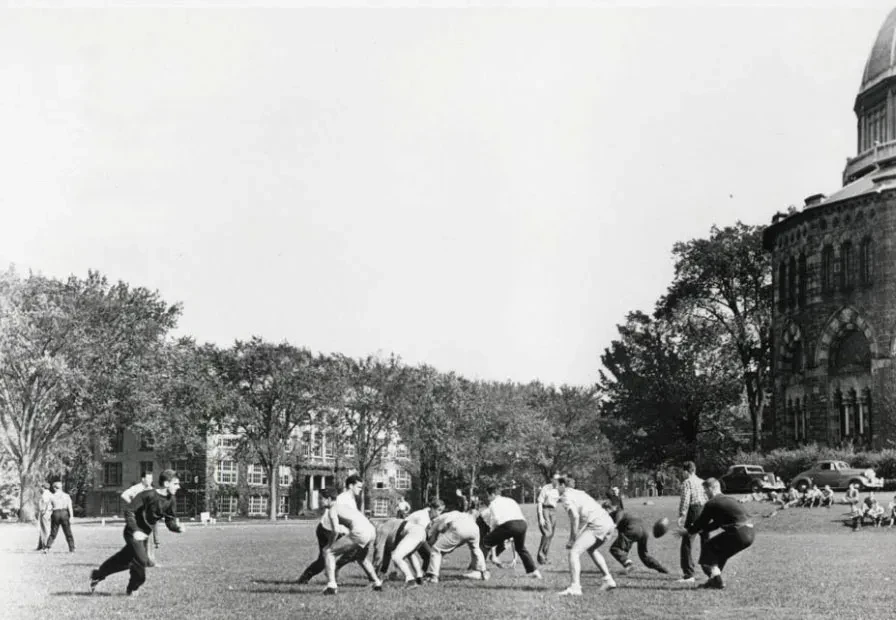
Shortly after he arrived at Union in 1938 as an exile from Japanese-occupied China, student Shui Kong Yuen taught himself photography. Carrying a Rollei Rolleiflex camera, he crisscrossed campus over the next four years and beyond to document everything from athletic contests and dances to architecture and fraternity life.
Yuen ’42 became Union’s unofficial photographer, amassing an impressive collection of photos both in quality and quantity.
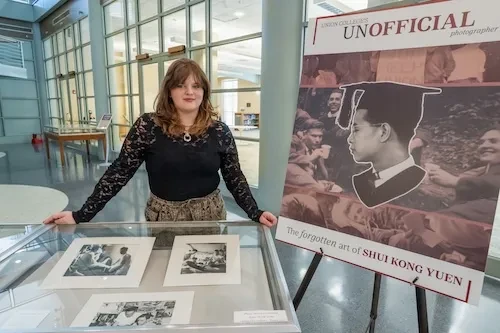
Jane Mae Schreiner ’26 is the curator of a new exhibit, “Beyond the Archive: Rediscovering the Art of Shui Kong Yuen” on display in Beuth Atrium in Schaffer Library.
His photos offered such an extraordinary snapshot in time of campus life that by Yuen’s senior year, the College decided to buy 20 of them as large size tone portraits.
“Never before in the history of Union has there been a collection of pictures of the campus, and very seldom have there been any pictures available of caliber of the ones by Yuen,” College Librarian Helmer Webb, told the Schenectady Union Star in announcing the acquisition in February 1942.
Yuen’s life and photos are the subject of a new exhibit curated by Jane Mae Schreiner ’26, “Beyond the Archive: Rediscovering the Art of Shui Kong Yuen” on display in Beuth Atrium in Schaffer Library.
An opening reception is from 12:50 to 1:50 p.m. Friday, March 6. The exhibit is free and open to the public.
The exhibit features 17 out of the more than 2,000 photographs donated by Yuen to the College in the 1980s.
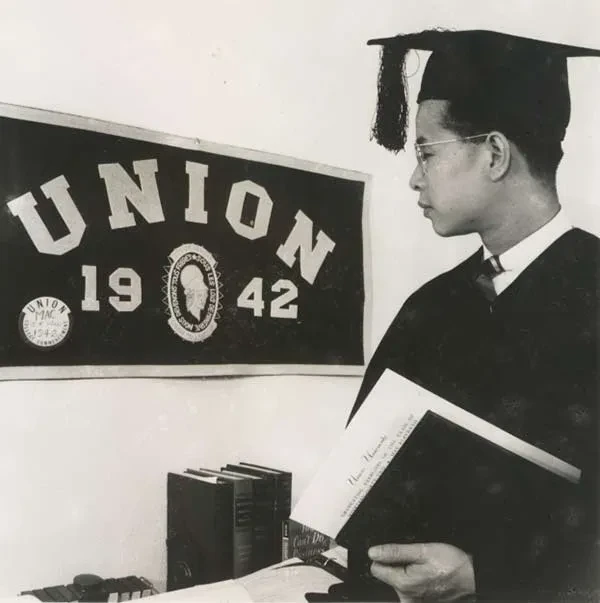
A self-portrait of Shui Kong Yuen '42, Union’s unofficial photographer.
A visual arts and art history major from Cornwall, N.Y., Schreiner was first introduced to the collection during a photography class. She developed a stronger interest in Yuen’s photography as an Evans Research Fellow and a student assistant in the College’s Special Collections and Archives.
While never recognized as art, Yuen’s work maintains great emotional resonance and artistic consideration, Schreiner believes.
“During my independent exploration of the over 2,000 silver prints and negatives, I felt that they had been brushed off as two-dimensional captures of student life,” she said. “Within them, I found thoughtful and complicated themes of a student constantly plagued with reminders of the war, his separation from his family and culture, and an embrace of Union as an oasis.”
Schreiner conducted biographical research to connect with the person behind the lens. This guided her in properly curating a selection of images while learning about the complex inner workings of archives.
Yuen was born in Hong Kong. He attended Fuh-Tan University in Shanghai until the outbreak of the Sino-Japanese war in 1937. He enrolled at Lingnan University, but after the Japanese bombed Canton, he decided to go to the United States, enrolling at Union in 1938.
Nicknamed “Mac” by students who found his name difficult to pronounce, Yuen studied economics and was a member of the Delta Phi fraternity. He initially set up an Omega enlarger in his study room at the fraternity house. Later, he used part of the attic in the General Engineering Building as his dark room.
At Prize Day in 1942, he was recognized for excellence in photography.
“Understanding the mind of Yuen allowed me to step into his shoes and see what he may have seen during image capture,” Schreiner said. “I worked to create a timeline of his life, referencing his photography to provide glimpses of his mental state, personality and interpersonal themes.”
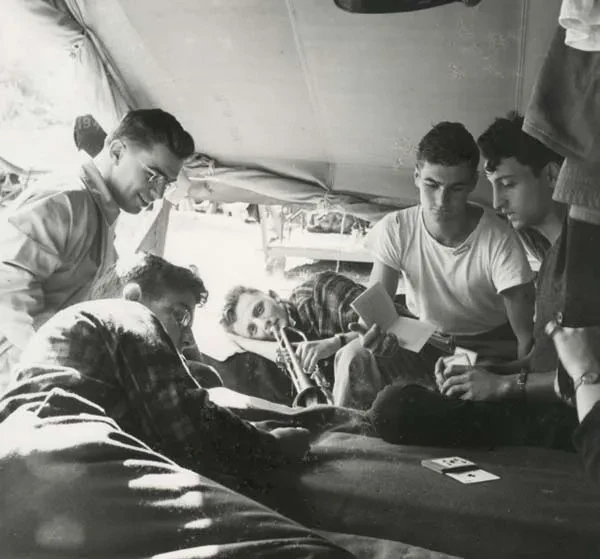
An image featured in the exhibit, titled "Freshman camp, 1941."
In assembling her exhibit, she spoke to collections managers, conservators and others from museums, such as the Metropolitan Museum of Art, for their expertise.
“Connecting with these experts served a dual-purpose,” she said. “It gave me the opportunity to imagine myself five years ahead. I stepped into their shoes and allowed myself to find what inspired me the most. I found that, beyond archives, connecting with others, managing my own project, and recovering something that may have been lost was one of the most transformative experiences I have ever had with art. This fellowship not only gave me the clarity to confidently identify what I want to do as a career, but it taught me the fundamental skills necessary to pursue it in and beyond my studies here at Union.”
After graduating from Union, Yuen worked at General Electric in its accounting department until 1946, during which time he continued to take photographs of campus events. He then returned to Hong Kong to join his father's real estate business. In Hong Kong, he aided refugees from Communist China, was a prime mover in founding a branch of Canton Lingnan University and served as an admissions representative for Union.
He and his wife, Wah Lok Yuen, had three children, including two who attended Union: Wai (Warren) Lum ‘75, Yee (Yvonne) Mun and Yan (Steve) Gee ’79.
Between 1981-85, Yuen sent more than a dozen boxes of his photos from Hong Kong to Union. He died in 1992.
“This exhibition aims to display his work as fine art, not as an attempt to increase its inherent ‘value,’ but to appreciate Yuen’s dedication to the documentation and display of his life,” Schreiner said. “His camera was his means to connect with his peers during a time of great uncertainty in his life, a feeling that resonates with students at Union today.”
The exhibit runs through March 20. A digital exhibition will go online during the spring term.