Pic Kerins ’28 is majoring in psychology and gender, sexuality and women’s studies.
Already fluent in English and Japanese, she’s also minoring in Chinese because she believes it will be beneficial down the road.
“Learning a new language translates to learning a new culture, which is fun but also makes you a more open-minded person,” Kerins said. “Having Chinese under my belt will help with the job market, too, since it’s such a widespread language. Lots of companies and government branches value Chinese language skills.”
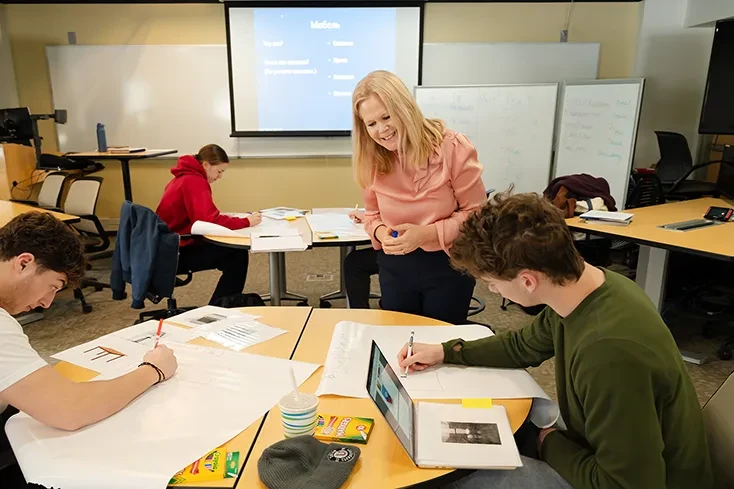
Kristin Bidoshi, professor of Russian, teaches a class.
She’s right. Language does create opportunities.
“Studying Russian at Union shaped the trajectory of my life,” said Luke Wochensky ’02. “The language training opened doors that would otherwise never have existed – from studying abroad in Russia to working with clients, governments and multinational businesses across the post-Soviet region.”
Wochensky lives in East Aurora, N.Y., but works abroad as a partner at Kinstellar, a leading law firm in central and eastern Europe, southeast Europe and central Asia. He speaks Russian and English with native fluency, and Slovak and French with intermediate fluency. Wochensky is also deputy supervisor and a council member of the Town of Aurora.
“I use Russian almost daily in my legal practice, which allows me to work directly with colleagues and authorities in central Asia to review documents in the original language and to understand the cultural and historical nuances behind transactions and disputes,” he said. “Union gave me the confidence to pursue a career that is international. The ability to step into unfamiliar cultures, understand different perspectives and build bridges, whether in central Asia or western New York, started with language study.”
Michele Ricci Bell, associate professor of German and chair of the Department of Modern Languages and Literatures, wants all students to know the value of language skills like Wochensky’s and Kerin’s.
“Language and interpersonal communication consistently remain top priorities employers seek,” she said. “Nine out of 10 employers rely on U.S.-based employees with multilanguage and intercultural skills – 32 % depend highly on these employees.”
Which is why Bell and her colleagues, Megan Ferry, professor of Chinese, and Kristin Bidoshi, professor of Russian, are embarking on a new project -- “Language in Present Tense: Modeling, Mentoring and Mapping Language Proficiency for Career Readiness.”
“We were inspired to find additional ways to reach out to more students and show them that the language skills they have are important for life and work after college,” Bell said. “We want to reinforce students’ instinctive draw to languages and support their learning with concrete explanations as to why multilingual abilities are valuable and important for human relations.”
“One in four employers report having lost business due to a language skills gap. Our graduates can fill that need,” she continued. “We want to convey to students who have yet to take a language, and reinforce for those who are already multilingual, that language classes are training for the future.”
The project, funded by a competitive grant from the Modern Language Association, is a multi-pronged approach designed to promote awareness of the career-ready skills afforded by foreign language study – as well as the value of Union’s multilingual community.
Prong 1: Employability
For this facet of the project, Bell, Ferry and Bidoshi are creating a series of modules for use across first and second-year courses in most languages offered at Union, which include Chinese, French, German, Japanese, Russian and Spanish. These modules will enhance the integration of career-readiness through targeted interventions that teach students how to maximize language skills across disciplines and professions.
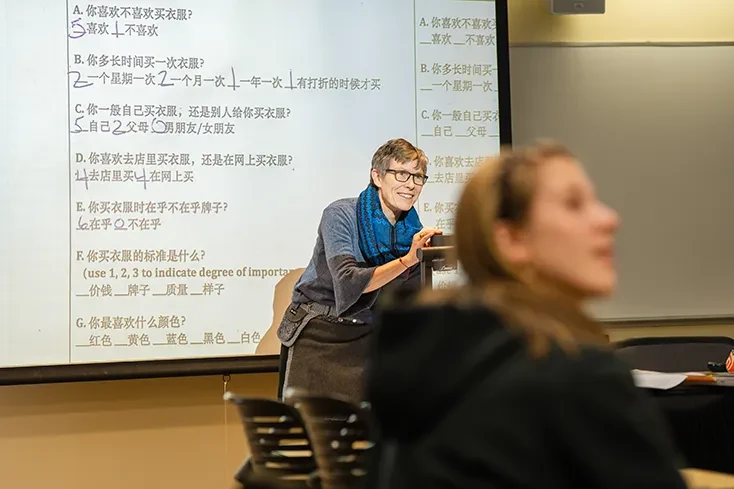
Megan Ferry, professor of Chinese, teaches a class.
“Languages are, by nature, an applied field. We use language to communicate on a range of topics, from economics to technology, art and philosophy. In any given language class, you might have students talking about the reasons behind an economic crisis or tracing political and social developments or comparing scientific and technological solutions to a global problem,” Bell said. “And they do all this in the target language!”
“Our classes give students the platform to use the knowledge they’ve gained from other disciplines,” she added. “It’s these kinds of soft skills that employers need in new hires, regardless of the particular field.”
A few of these modules have already been implemented – first with students in the Arthur O. Eve Higher Education Program (HEOP) and Academic Opportunity Program (AOP) this past summer. More modules will be introduced for all students going forward, beginning with German and Russian during the next two terms.
Introducing the modules first with HEOP/AOP students made sense.
“As confirmed by a pre-module poll we conducted last year, many AOP/HEOP students arrive at Union as multilingual learners and aspire to pursue language study across our programs,” Bell said.
Prong 2: Language map
In creating a map of languages spoken at Union, Bell and her colleagues hope to do two things: clear up a misconception and reinforce pride.
“By collecting and sharing data about languages spoken across campus, we aim to debunk the myth that languages are only used in Karp Hall (home of Modern Languages and Literatures),” Bell said. “With the map, we instead emphasize that languages are already among us and draw attention to the ways language is embedded in our community.”
“For example, more than fifty percent of our HEOP/AOP students in the Class of 2028 come from multilingual households, including speakers of Spanish, Polish, Yiddish, Malay and Hindi,” she continued. “This map aims to reinforce student pride in this fact and invite them to see language as an asset they can marshal for career preparation.”
Inspired by a similar map from the Endangered Language Alliance, Bell and her colleagues will survey members of the Union community to determine how many languages are spoken on campus and where. The Computer Science Department is assisting with the effort, and students will be recruited to help as well.
“We will include students in various stages of this project, including data processing and analysis, and technical implementation of the digital map,” said Bell. “We see this map as a way to engage students across fields in a truly interdisciplinary activity that shows how language integrates and unites us all.”
“We expect the map and survey will be useful for future senior theses and research,” she added. “Other colleges are also already excited about this work we are doing.”
They hope the map will be complete and ready for use this fall.
Prong 3: Alumni-student network
To further showcase the value of language skills, Bell, Ferry and Bidoshi are also creating an alumni-student network. They want students to have the opportunity to get to know alumni like Wochensky, and benefit from their professional experience utilizing language in their careers.
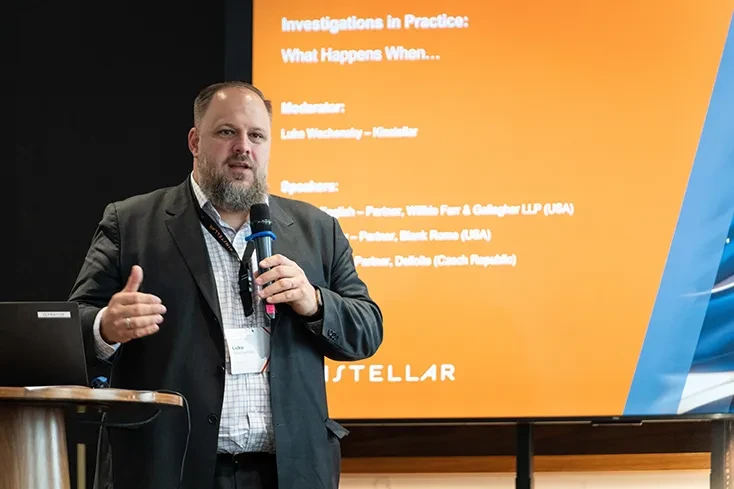
Luke Wochensky ’02 speaks at Compliance Day in Prague. He lives in East Aurora, N.Y., but works abroad as a partner at Kinstellar, a leading law firm in central and eastern Europe, southeast Europe and Central Asia.
“This network will allow for concrete, specific connections to alumni whose fields are related to students’ interests,” Bell said. “At the same time, it will provide our students with models of the wide variety of pathways that language majors and minors pursue – beyond what they could imagine before they had this knowledge.”
“In this process, students will also come to see the different ways in which language study supports career readiness,” she added. “This often includes language proficiency itself but also an array of implicit skills that our alumni can attest to benefiting from.”
Take Wochensky, whose language skills have benefited him immensely – well beyond simply facilitating communication.
“We live in a world where businesses, governments and even small communities are interconnected. Whether you’re working on international sanctions, supply-chain issues, technology, public policy or local community leadership, an understanding of how people in other cultures approach problems is tremendously advantageous,” he said. “Language is not just about vocabulary – it teaches analytical flexibility, empathy and the ability to see issues from multiple angles. These are skills the modern world rewards.”
“And personally, foreign languages have enriched my life by making travel, friendships and cultural experiences deeper and more meaningful,” Wochensky added. “The greatest benefit, though, is perspective. Language gives you access to how people think, not just what they say.”
Ricci, Ferry and Bidoshi hope to have the mentorship pipeline at least partially in place by spring term. They are also working on posters that will be hung in Karp Hall, showcasing alumni who are using their language skills in diverse professional arenas.