Each May, hundreds of students showcase their creative and scholarly work during Steinmetz Symposium Day. But all the performances and talks presented that day take months to prepare. Here’s just a glimpse of some of the research, refining and rehearsing that goes into getting ready for the big day.
Jared Antoine
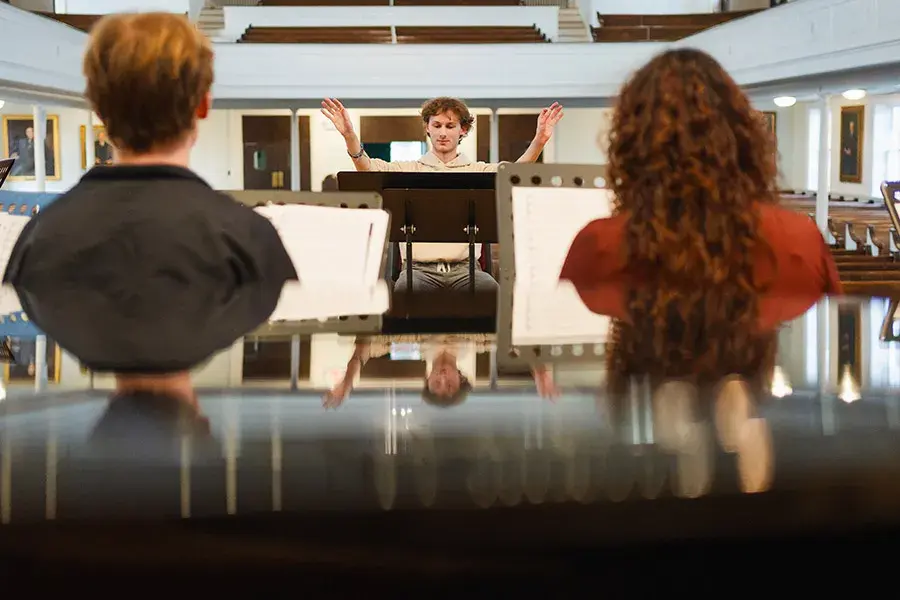
Antoine leads choir members performing his original hymn, Ecce Quam Bonum. Drawing its text from a Latin psalm, the piece centers on a message of unity and community. “The main theme roughly translates to ‘how beautiful it is for everyone to live in unity,’” Antoine said. “This phrase is what resonated with me when constructing the piece, and I hope others will latch onto it as well.”
Mehir Badlani
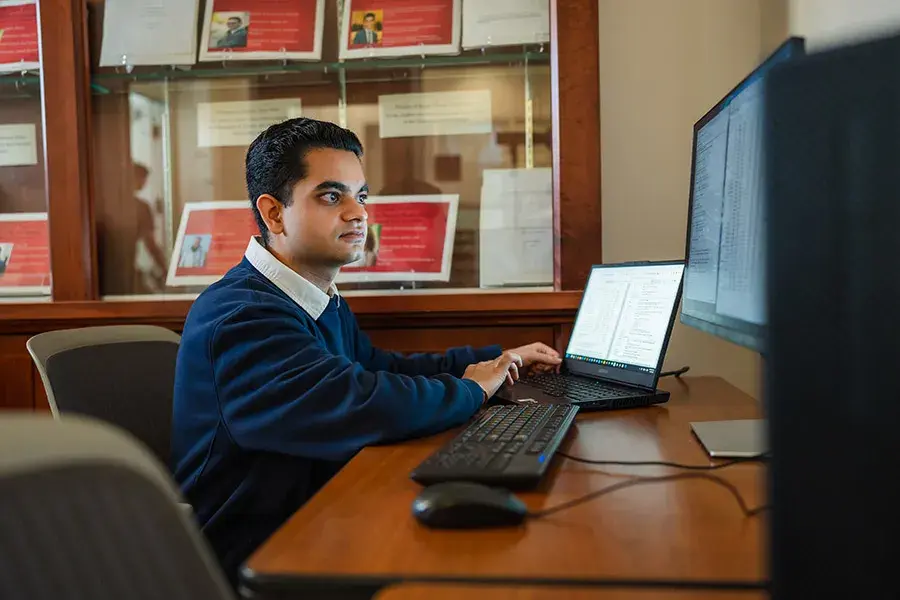
Badlani, an Economics and chemistry major in the Leadership in Medicine Program, analyzes data for his Steinmetz research, “Estimating the Impact of English Language Proficiency on Immigrant Healthcare Utilization.” His work explores how English language proficiency influences healthcare access and utilization among immigrant populations. Badlani says the research can help inform efforts to improve care for people with limited English proficiency in the United States.
Brian Breslow
Breslow, a mechanical engineering major, works on his Steinmetz Symposium research in Schaffer Library. His project explores non-chemical energy storage systems, with a focus on sand battery technology and its potential as a more renewable solution for power generation. Breslow’s research examined how innovative energy storage methods can help support the transition to a more sustainable energy future.

Danielle Brown
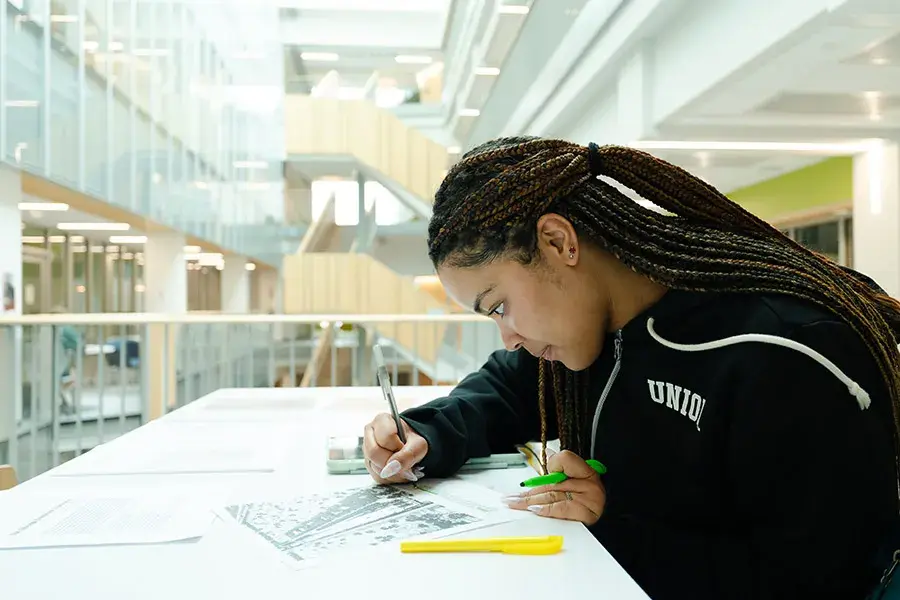
Brown, an Africana Studies and Economics major, works on her research for the Steinmetz Symposium. Her project, “Routes of Inequality: Highways Infrastructure in Conjunction with Black Activism on the Racial Wealth Gap in Chicago,” examines how highway development and community activism have shaped Black neighborhoods. Comparing areas affected by a highway that displaced residents with those where a proposed highway was stopped through protest, Brown explores how infrastructure decisions, home values and Black activism have influenced the racial wealth gap.
Eduardo Castro
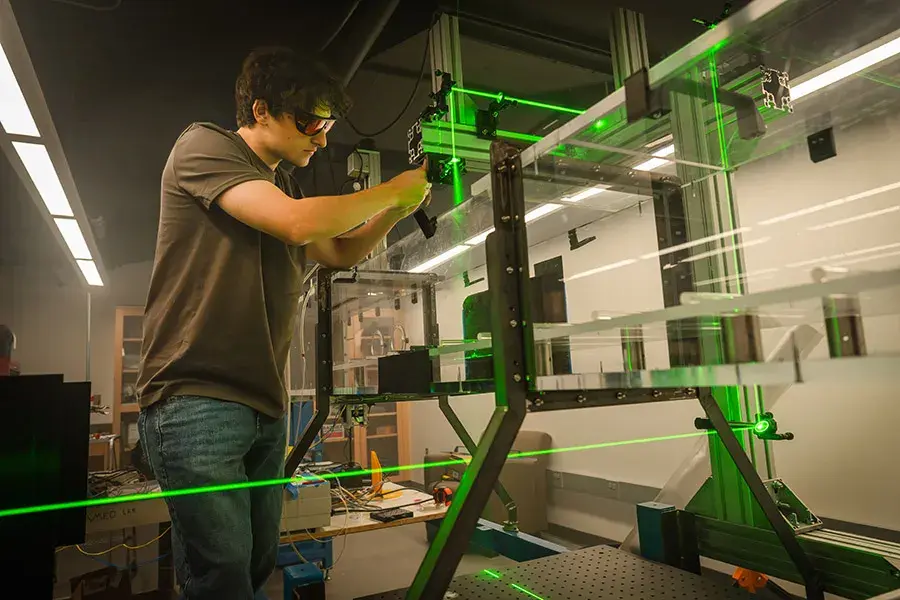
Castro aligns laser lenses in the wind tunnel lab as part of his Steinmetz Symposium research. His project explored how heating a rough surface affects turbulent fluid flow and the behavior of air moving across it.
Ava DuBoff
DuBoff, an environmental science major and dance minor, rehearses with dancers performing her original choreography for the Steinmetz Symposium piece “Worldview.” Created in collaboration with her father, who composed the music, the work responds to the climate crisis and explores themes of ecological grief and environmental change. DuBoff blends her academic studies and artistic practice, shaping a piece that invites dancers to bring their own interpretation into the movement.

Willow Melton and Sedona Baird
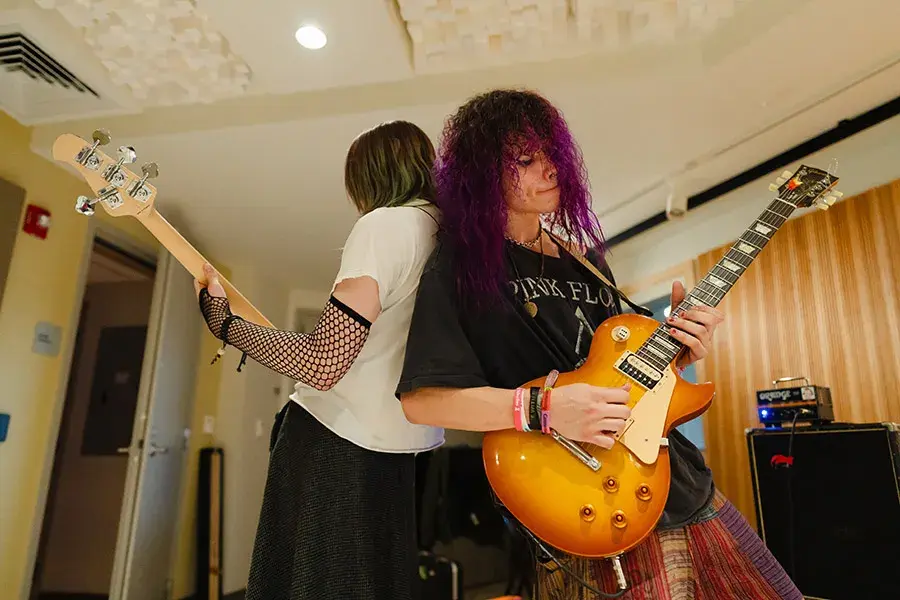
Melton, left, and Baird rehearse in The Acoustics Research, Design, and Instructional Studio (TARDIS) as members of the band Faggle of Cunks. The duo performed their original song, “Petricholeum,” at the Steinmetz Symposium. Inspired by reports of oil falling from the sky following the bombing of an oil facility during the recent U.S.-Iran conflict, the song uses satire to examine the consequences of wartime decision-making and contemporary foreign policy.
Anne Pearl
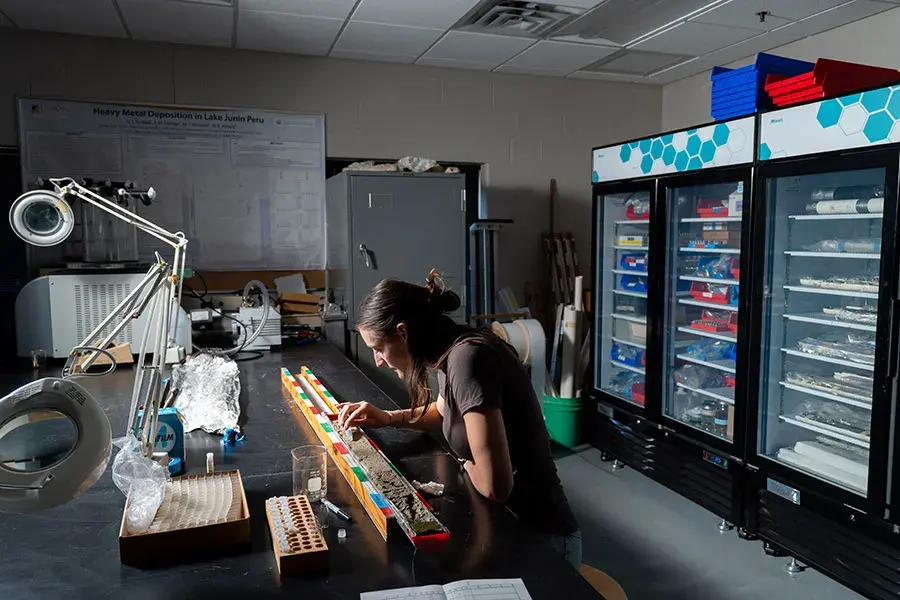
Pearl, an environmental science major with a geoscience concentration, works in the Geoscience lab with a sediment core sample from her summer research in Peru. Her research compares lake cores from Peru and the Adirondacks to reconstruct past climate conditions using stable isotopes and study climate variability and human impact over the last 500 years.
Armaan Uppal
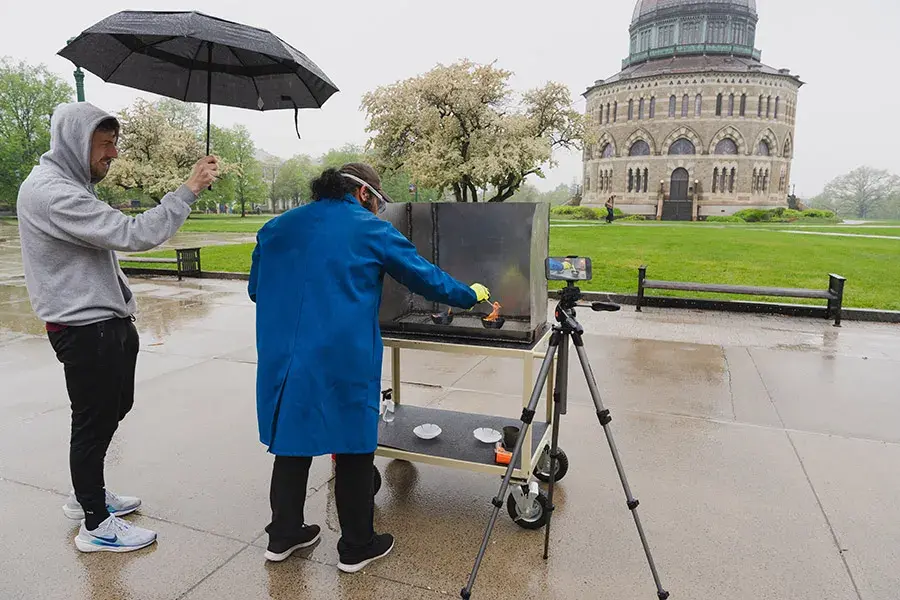
Uppal works on research for his presentation investigating the possible composition of Greek fire. His work begins with translating and analyzing Greek texts and historical accounts from the 7th to 14th centuries, examining descriptions of battles and how Greek fire was used to identify clues about its formulation and handling. He then explored experimental mixtures and material combinations to evaluate potential compositions based on historical evidence and recorded properties.