Ella Bardzilowski, a junior at Grinnell College, spends her days on Union’s campus designing a sustainable clay material that can remove copper from water under acidic conditions.
Copper can enter drinking water through the pipes, which is more likely under acidic conditions. Exposure to high doses of copper can cause health problems
Working with her mentor, Sara Denison, assistant professor of environmental engineering, Bardzilowski is testing clays that are naturally absorptive and remove contaminants using low-energy processes.
“This experience has been incredible,” said Bardzilowski, a biology and sociology major from Princeton, N.J. “I have developed a close relationship with Professor Denison as we work together one-on-one. She has taught me so much already about the process of research, including to always view setbacks as pathways for growth.”
Bardzilowski is one of 10 students from colleges across the country who have made Union their second home this summer. They are part of a unique engineering program designed by Ali Hamed, the Thomas J. Watson Sr. and Emma Watson Day Associate Professor of Mechanical Engineering and department chair, and Ann Anderson, the Agnes S. MacDonald Professor of Mechanical Engineering.
Inspired by Union’s unique position as a liberal arts college with strong traditions in engineering and undergraduate research, the two professors wanted to create a research experience that goes beyond standard lab work.
The pair’s work led to a prestigious National Science Foundation grant to host a Research Experiences for Undergraduates (REU) site. The $429,000 grant will fund the participation of 10 students per year for three years.
The program offers students an experience where technical engineering research is placed within wider contexts through engagement with the liberal arts and entrepreneurship. By combining faculty-mentored engineering research with liberal arts lectures, professional development workshops and the newly designed U-Corps entrepreneurial curriculum, Hamed and Anderson designed an eight-week summer curriculum.
Undergraduates are given a well-rounded picture of how engineering research is performed, how it impacts society and how it can move from an initial idea in the lab to a meaningful real-world solution.
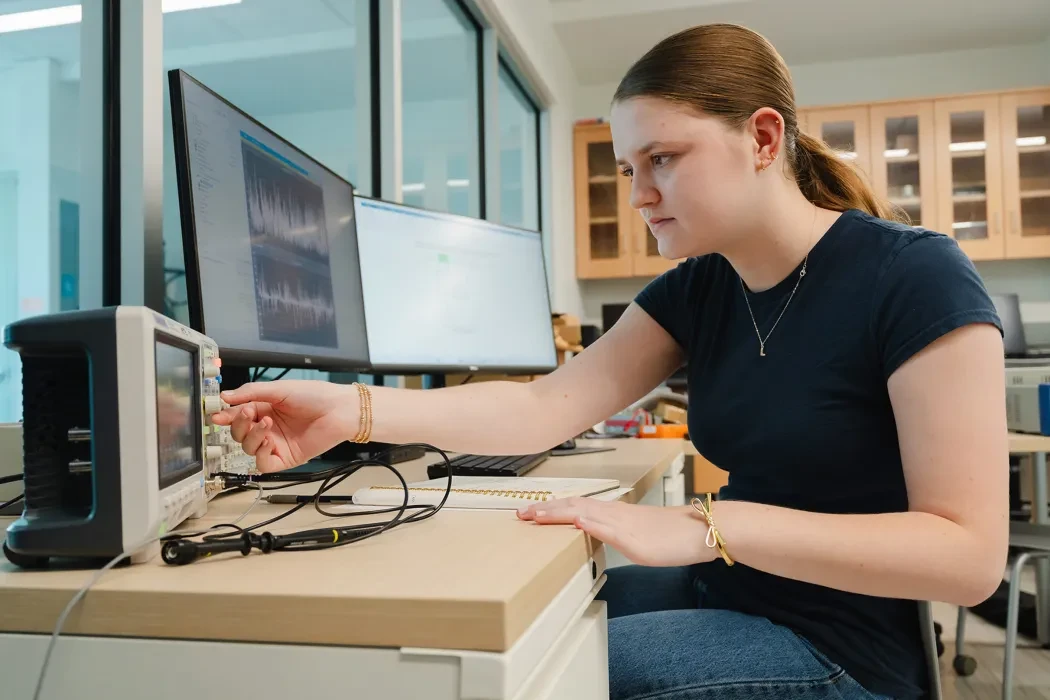
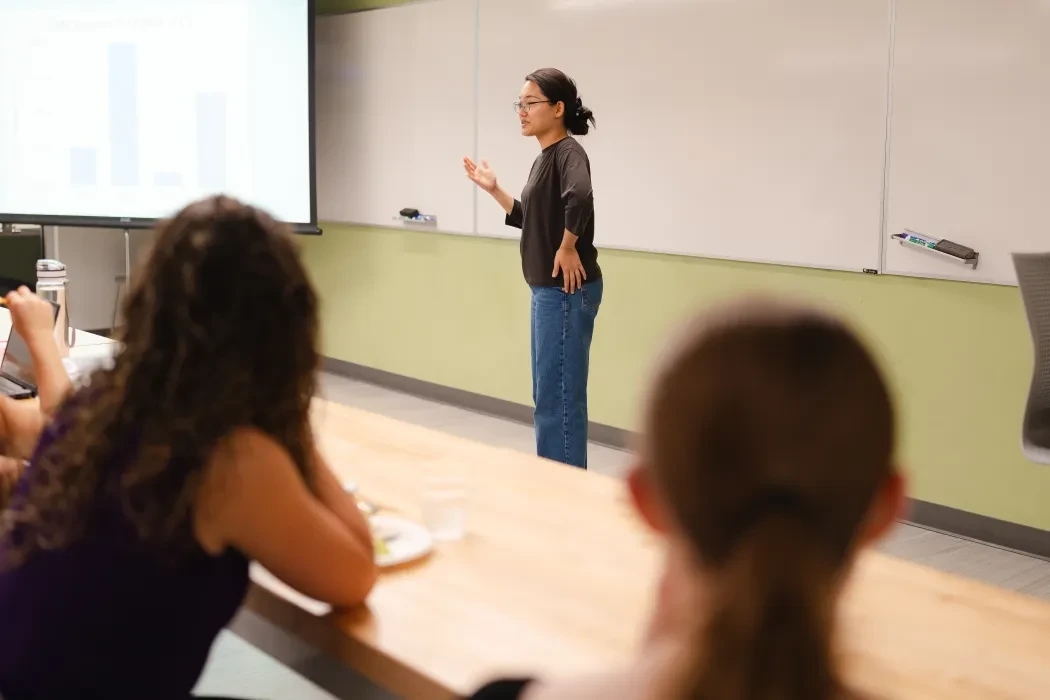
More than 140 students applied to be part of the first group of students enrolled this summer. Lily Eagen ‘29 is one of two Union students selected to participate. An electrical engineering major from Northport, N.Y., Eagen’s project surrounds modelling the Kundur Two-Area System (a simple power grid model used for baseline analysis) and studying how random dynamic loads affect the stability of the grid. She is mentored by Luke Dosiek, the William D. Williams Professor of Electrical and Computer Engineering.
“Joining this program has given me insight into the general research process, specifically the trial-and-error part,” Eagen said. “Because I didn't have much electrical engineering experience, it took me a while to figure out how power grids function, what all the different power grid elements are and how to use the software in the lab. Not only has this program taught me about power grids, it taught me how to turn research into a marketable product through the U-Corps program, which has been very interesting, especially considering I had no entrepreneurship experience prior to this.”
Another Union student, Hannah Lee ’28 is part of a group working with Stephanie Curley, the Mary H. '80 and Richard K. Templeton '80 Assistant Professor of Biomedical Engineering. They are focused on designing vaccine platforms for Lyme disease as well as the development of needle-free vaccine options.
Lee was drawn to the program after returning from a term abroad in Brazil, where she saw healthcare barriers caused by resource and budget constraints.
“I became more interested in the practical applications of my research,” Lee said. “I began to ask myself who would benefit from shelf-stable vaccines and how they could improve lives. This program was the perfect opportunity for me to continue research while finding a clear sense of purpose: knowing who the science serves.”
She recommends the program for other students interested in engineering.
“Conducting research is one thing, but understanding why it is needed is another,” said Lee, a biomedical engineering major from Tokyo. “This program has opened my eyes to what drives these researchers and who ultimately benefits from their work. While the program aims to bridge the gap between research and commercialization, I strongly recommend it to students who are mission-driven and want to understand the impact of their research beyond the lab.”
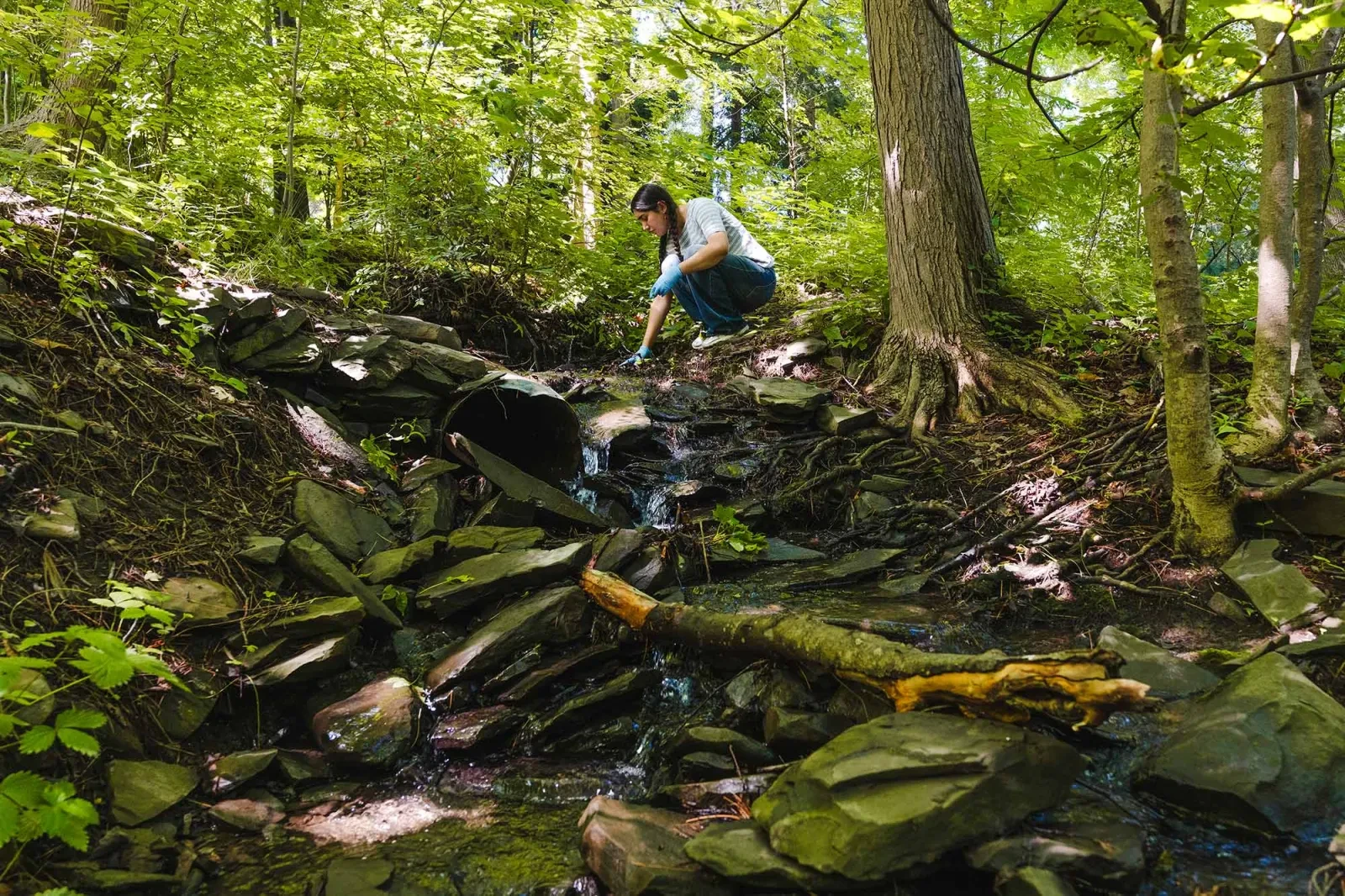
Scripps College student Stephany Rodriguez collects a water sample from a stream leading into the Hans Groot Kill in Jackson's Garden on the Union College campus. Rodriguez is researching sewage detection in the environment.
Madden Toedtman learned about the program through one of his academic advisors at Boston College, where he is a senior majoring in human-centered engineering and global public health and the common good. He is studying turbulent flow over rough surfaces with Hamed.
“I had previously applied to NSF REU programs, but was excited about Union's, in particular, as my home institution has a broad engineering curriculum,” he said. “I was interested in digging further into engineering in a liberal arts context.
“Professor Hamed has been a terrific mentor and I have learned a lot about turbulent flow and what sustained academic research has looked like. Professor Anderson has also done an excellent job with the U-Corps programming, and I am learning a lot about transitioning ideas and projects from the lab to the commercial space.”
As the program winds down in early August, students will have developed strong technical skills through faculty-mentored research, understand the societal impacts, ethical considerations and human element of their research, learn the path to innovation and build career pathways.
“We want to give students more than the typical lab experience,” Anderson said. “By pairing rigorous engineering research with liberal arts perspectives, professional development and our U-Corps entrepreneurship programming, students learn to see their work through a much broader lens.”
Hamed added, “We want to make sure they leave Union not only as stronger technical researchers, but as strategic thinkers who understand the societal value and potential real-world impacts of what they studied.”
REU PARTICIPANTS
Henry Aung
Institution: Mohawk Valley Community College
Union mentor: Chandra Pappu
Project: Radar Communication Systems and Signal Processing
Ella Bardzilowski
Institution: Grinnell College
Union mentor: Sara Denison
Project: Soil and Water Remediation
Keegan Brady
Institution: Hudson Valley Community College
Union mentor: Ali Hamed
Project: Turbulent Flow over Rough Surfaces
Thomas Bundy
Institution: Swarthmore College
Union mentor: Ann Anderson
Project: Development of an Aerogel Printer
Lily Eagen
Institution: Union College
Union mentor: Luke Dosiek
Project: Electric Power Systems
Hannah Lee
Institution: Union College
Union mentor: Stephanie Curley
Project: Development of Shelf-Stable Vaccines
Juan Mosqueda
Institution: San Jose State University
Union mentor: Chandra Pappu
Project: Radar Communication Systems and Signal Processing
Stephany Rodriguez
Institution: Scripps College
Union mentor: Carrie Rodak
Project: Sewage Detection in the Environment
Senajith Sooriyamoorthy
Institution: Monroe Community College
Union mentor: Luke Dosiek
Project: Electric Power Systems
Madden Toedtman
Institution: Boston College
Union mentor: Ali Hamed
Project: Turbulent Flow over Rough Surfaces