George W. Smith, lifelong educator, professor emeritus of biological sciences, civil rights advocate and community servant, died March 23, 2026, at his home in Schenectady, N.Y., at the age of 86.
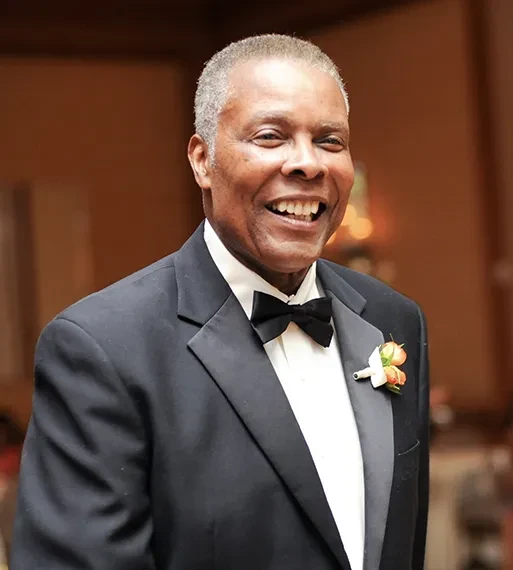
A celebration of his life will be held on campus Saturday, Aug. 22, at 11 a.m. in Memorial Chapel. All are welcome.
Smith leaves behind a legacy that includes generations of former students. Many of them – like biology major Amanda Famolare Votto ’00 -- remember him “as a kind and brilliant professor who took time to know and care about his students.”
“The memory that stands out most for me is when I walked by Professor Smith’s classroom upon returning from a term abroad in Italy. His whole face lit up,” recalled Votto, who is now a physician assistant practicing cardiology in Connecticut. “He was genuinely so happy to see me and had noticed I had not been around for a few months.”
“Professor Smith made an important impact on my experience at Union, and I often think of him,” she continued. “He made his students feel special and knew us on a personal level. His legacy will live on through his family and all the students that he taught over his lifetime.”
Born Feb. 25, 1940, Smith was the eldest of 13 children. Growing up in Clewiston, Fla., he was drawn to science from a young age. Watching his sister battle lupus, Smith saw the complex biological story behind disease and was inspired to pursue science as a way of understanding it.
And so, after graduating from Booker T. Washington High School, he earned a B.S. in chemistry and biology from Bethune Cookman College. Smith went on to earn an M.S. from Virginia State University and he received his Ph.D. in cell biology from the University of Virginia in 1973. He made history as the first African American to earn a Ph.D. from the university's biology department.
Smith’s interest in understanding cell biology encompassed a passion for teaching it, too – for inspiring young people, challenging them and helping them harness their potential. After graduating from Bethune Cookman College, he returned to his high school to teach.
For Smith, science and education were pathways to understanding the world, but they were also pathways to empowering the next generation to reach even greater heights. And that’s what he did for decades at Union College, starting in 1973, for students like Lee Cohen-Gould ’77.
In her junior year, Cohen-Gould took “Cytology: The Biology of the Cell” with Smith. It was in the lab portion of that course that she first learned the basics of light and electron microscopy. The following year, Smith invited her to be the teaching assistant for that course.
“I jumped at the opportunity. Teaching others how to do things really solidifies that knowledge and I was hooked,” said Cohen-Gould. “I applied to graduate programs where I could continue to hone my skills. My first job out of grad school was in a lab at Albert Einstein College of Medicine that used electron microscopy to study the ultrastructure of the heart.”
“After that, I took a position as the director of the research electron microscopy lab at Weill Cornell Medical College. I recently retired from my position there as senior director of microscopy and image analysis, ending a 46-year career that was made possible by what I had first learned at Union with Dr. Smith.”
Smith, who taught lectures and labs in introductory biology, cell biology, cytology and histology, as well as senior seminar courses, was the recipient of multiple cancer research awards on cell motility and microtubule proteins, with support from the National Cancer Institute and the Mellon Foundation. He conducted pivotal research in cancer at Baylor School of Medicine in Houston, Texas, and the Marine Biological Laboratories in Woods Hole, Mass.
Smith also actively championed educational opportunities outside the classroom at Union and in Schenectady.
He was founder and director of the Science and Technology Entry Program, designed to prepare economically disadvantaged students to enter college and increase participation in math, science, technology, health-related fields and licensed professions. STEP is still thriving today as part of Union’s Kenney Center for Community Engagement and Outreach. Smith was a proud member of Alpha Phi Alpha Fraternity and Sigma Pi Phi Boule as well and helped develop the Martin Luther King School Computer Center in Schenectady.
Additionally, Smith, who retired from Union in 2005, served as an ordained deacon at First Reformed Church (Schenectady) and as treasurer for the National Association of Minority Medical Educators and for its New York state chapter.
Smith was also deeply committed to civil rights and community advocacy his whole life. This dedication began during his early years at Bethune Cookman College in Florida, where he led many sit-ins at local restaurants and the Greyhound Bus Station. He was jailed twice for his civil rights activities.
When Smith moved to New York, his calling and passion for equality and advocacy continued with his service as president of the NAACP of Schenectady in the 1980s. Later, recognizing his dedication to community and education, and his work with the Booker T. Washington Reunion Alumni Committee, Smith was awarded a plaque and key to the city of Clewiston, Fla.
Smith is survived by Esther E. McPhail Smith; their two daughters, Valerie A. Smith Woodfolk and Vynedra A. Smith MD; and three grandchildren, Aaron Jr., Elise and Cherise Woodfolk. He will be remembered for his love, kindness and unwavering belief in others. Learn more about Smith's life here.