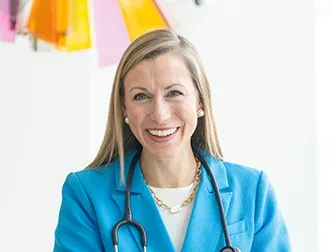
This scarcity affects us all: Alumni doctors discuss the healthcare provider shortage
Publication Date
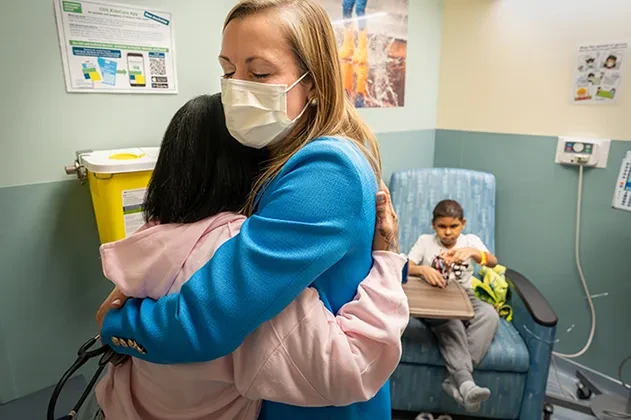
Dr. Jamie Flerlage ‘05, division chief for pediatric hematology/oncology at the University of Rochester’s Golisano Children’s Hospital, hugs her patient’s mother, Mercedes Marti.
We’ve all experienced it—either ourselves or through a loved one. The days-long wait for a bed in the hospital. The weeks-long wait to see a primary care doctor. The months-long wait for that specialist appointment.
It’s agonizing, but unsurprising, given the shortage of healthcare providers. Which will get worse.
By 2036, the Association of American Medical Colleges (AAMC) predicts the shortage will be between:
* 13,500 and 86,000 for physicians
* 20,200 and 40,400 for primary care physicians
* 10,100 and 19,900 for surgical specialty physicians
(Source: AAMC March 2024 report, “The Complexities of Physician Supply and Demand: Projections from 2021 to 2036”)
Here, two respected alumni physicians discuss what’s behind this shortage, how we might address it and the struggle they and their patients face every day.
The impact: On providers & patients
“This shortage is very real, extraordinarily real,” said Dr. Gregg Meyer ’84, a primary care physician who is also a professor of medicine at Massachusetts General Hospital and Harvard Medical School. “I am part of a group of physicians who rotate practice-to-practice, depending on where the shortage is greatest. This wasn’t necessary 15 years ago. It’s essential now.”
This rotating role, he says, is illustrative of the problem.
“Many of our physicians are now retirement age and are serving an over-size number of patients who have aged with them,” said Meyer, who is also a professor of health policy and management at Harvard Chan School of Public Health, and senior clinical and strategic advisor at Albany Med Health System (N.Y.). “As a result, there is not a one-to-one replacement opportunity, and we are constantly facing a deficit in providers.”
“The sad truth is that I’ve seen a number of patients who have gone months without getting appropriate follow-up care because they didn’t have access to primary care due to breaks in service with their provider,” he continued. “This often leads to delays in care for significant conditions such as cancer and heart disease. In the end, this is an incredible price we’re all paying for the physician shortage.”
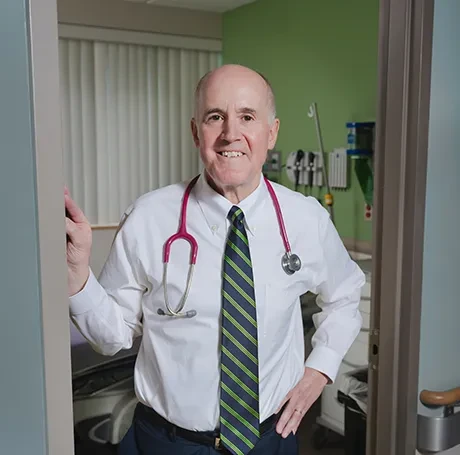
Dr. Gregg Meyer ’84, primary care physician and professor of medicine at Massachusetts General Hospital and Harvard Medical School; professor of health policy and management at Harvard Chan School of Public Health; Rhodes Scholar; senior clinical and strategic advisor at Albany Med Health System (N.Y.)
Dr. Jamie Flerlage ’05, division chief for pediatric hematology/oncology at the University of Rochester’s Golisano Children’s Hospital, knows exactly what he means. Her institution often relies on providers who come in to fill gaps.
“We have to use more traveling nurses than in the past. Travelers are amazing but are not a long-term solution. They leave after their assignment and must be retrained each time they come on board since no two jobs, workflows or even computer systems are the same,” she explained.
“Post-COVID, there remain many challenges in adequate staffing. Hiring at all levels is tougher than it used to be,” continued Flerlage, who is also assistant director for clinical research at Wilmot Cancer Institute and is a lymphoma researcher who treats young adults and children. “With a smaller pool of people applying, it is harder to find the right skill set for the open job.”
This staffing deficit can be harmful.
“On its softest side, this results in inconvenience and delays for patients. But, unfortunately, delays in care translate into worse outcomes and it’s not just the patient experience outcomes, it’s harder clinical outcomes,” Meyer said.
Flerlage agreed.
“Shortages will continue to lead to delays in care, longer wait times for testing and treatment and the closure of smaller, outlying centers that allow people to receive care closer to home,” she said. “But it is not just the availability of cutting-edge technology and novel drug therapies that save lives—you also need the incredible humans who carry out and deliver these.”
And those humans—those providers—are having a hard time, too.
“The other side of this is what I think is appropriately described as the moral injury of physicians,” Meyer said. “When there are barriers to delivering care—when I can’t get my patients seen by specialists as quickly as I want—that wears you down. I know I am capable of doing better, but context and the environment prevent it. Over time, this is a major contributor of burnout.”
Flerlage, whose office oversees 125 clinical cancer trials each year, echoed these sentiments.
“Delivering medical care to ill and dying humans is a challenging job. Each day you must put things happening in your own life into a box and care for others,” she said. “If you have to do more with less staff and you cannot find time to process the unimaginable things you see every day—and make space for yourself to refill your cup—then you burn out.”
Causes & solutions
The causes of the healthcare shortage are complex, but the Association of American Medical Colleges identified several in its March 2024 report, including:
A. From 2021 to 2036, the U.S. population aged 65+ is projected to grow 34.1%—a figure that heralds a high demand for physicians who care for older Americans.
B. Physicians 65 and older made up 17% of the workforce in 2021, while those 55 to 64 made up 25%. More than one third of practicing physicians will likely retire within the next 10 years.
Considering these and other factors, Flerlage and Meyer offered thoughts on how to navigate and address the shortage.
“In general, the field of medicine is struggling. It is not as lucrative as business opportunities, has a very long training and education track, and administration and insurance companies have made it more challenging to practice medicine,” Flerlage said. “That being said, our healthcare needs are growing with an aging population.”
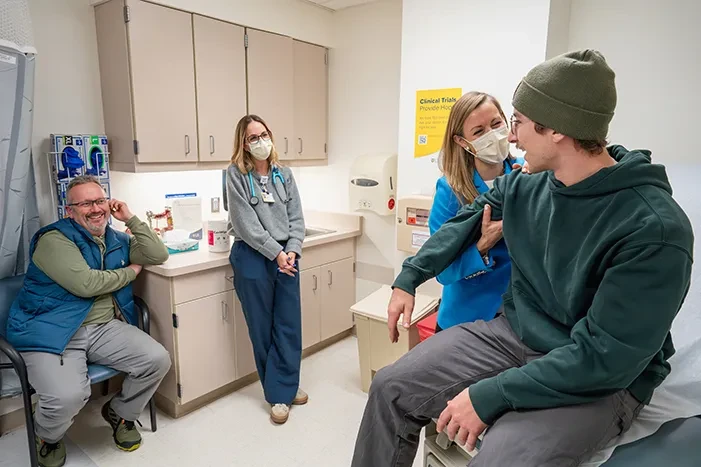
Dr. Jamie Flerlage ’05, division chief for pediatric hematology/oncology at the University of Rochester’s Golisano Children’s Hospital, checks over her patient, Jack Dyson.
“Nurses and physicians are needed in both rural areas and large cities,” she continued. “To continue to provide exceptional care for every patient, we must realize that many of these patients are cared for by physicians from other countries. We must support people from other countries to remain in the U.S. to fill these critical roles.”
Flerlage also stressed the importance of partnerships across borders to strengthen healthcare, not just locally, but globally. She runs a large international consortium called Global NLPHL One Working Group (GLOW), which includes 26 countries. The multidisciplinary research group facilitates international collaboration to optimize the diagnosis, care and outcomes for (and with) patients diagnosed with Nodular Lymphocyte-Predominant Hodgkin Lymphoma worldwide.
“Eighty percent of cancer patients will be diagnosed in low-middle income countries with fewer resources and limited access to imaging and novel treatments,” she explained. “Thinking through how we can apply our new research findings to others in the world is critically important for us all.”
Meyer, who has vast administrative healthcare experience and oversaw six hospitals when he previously served as executive vice president for value-based care at Massachusetts General Hospital Brigham, agrees collaboration with multiple stakeholders is important.
Policymakers need to look at whether it makes sense to make medical education more affordable or expand loan forgiveness programs or expand the number of medical schools, he said. “They can also help us move into the 21st century. Barriers like state-based medical licensure, for example, really don’t make sense in this age of telemedicine.”
Payers and insurers can also do their part to alleviate the shortage.
“Some of the administrivia that payers require in order for care to be paid for puts up a barrier and basically limits the medical workforce in terms of who can be seen for what,” Meyer said. “More flexibility is needed, particularly when thinking about the role of paraprofessionals and team-based care.”
Paraprofessionals who work alongside physicians are integral to a team-based approach, in which healthcare providers from different areas (doctors, nurses, pharmacists, social workers and so on) work collaboratively. They share information and responsibilities and provide holistic care for patients.
“For physicians, it’s important to really get involved in training not just residents and interns but training other healthcare professionals. They can help reduce the burden of caring for patients—by sharing it—with a shift to a team-based model.”
Patients can also be part of these teams and get more involved in co-producing their own care. Utilizing patient portals to stay informed about test results and treatments, to schedule appointments or communicate with providers outside an office visit can help relieve pressure on healthcare systems, Meyer added.
Meyer and Flerlage also offered some other helpful tips for patients in the midst of this shortage.
Advice to patients
• Ask questions | “People should always ask questions so that they understand if there is another option for their care elsewhere if a delay is occurring or they do not feel comfortable with their care plan,” Flerlage said. “But my main advice, if you are dealing with cancer, is to ask if there is a clinical trial open.”
• Clinical trials | “Frontline or phase 3 clinical trials provide treatment based on at least 10 years of knowledge and scientific discovery, and a lot has happened in the last decade,” she continued. “Patients are not here for trials; the trials are here for them. If there is an ongoing study, that means the trial administrators believe there is a higher cure rate or less toxic therapy than before. So, ask about a clinical trial!”
• Listen to your body | Meyer stressed the importance of listening to your own body. “One thing I see as a primary care physician that people tolerate is unexplained weight loss,” he said. “This is a red flag that people too often ignore, but it means something is not right.”
• Empower yourself | Meyer also recommended that people empower and equip themselves with tools that can help them understand when an injury or illness is an emergency. “Going to the ER or urgent care when you don’t need to, this puts stress on the system that it doesn’t need,” he explained. “Get a home blood pressure monitor. Get a pulse oximeter. If appropriate, wear a continuous glucose monitor and download and read that data. Being more active in your own care will give you reassurance and alleviate that need for an urgent visit.”
HOW DID YOUR TIME AT UNION PREPARE YOU FOR A CAREER IN HEALTHCARE?
“Union did three things for me. First, a broad liberal arts education is incredibly helpful for becoming a doctor. If you just went in and did straight science, I don’t think you would have the human qualities that make a great physician. Second, the small class sizes and intensity of the trimester system were great ways to learn a lot of science really quickly and build close relationships with professors. And third, I was part of the 6-year program with Albany Medical College. I had the privilege to take part in experiences—such as doing a term abroad studying socialized medicine—that clearly changed my life. They gave me exposure to healthcare broadly, rather than just focusing on an individual patient, and really looked at health systems and how they interact with communities and populations.”
— Dr. Gregg Meyer ’84, primary care physician and professor of medicine at Massachusetts General Hospital and Harvard Medical School; professor of health policy and management at Harvard Chan School of Public Health; Rhodes Scholar; senior clinical and strategic advisor at Albany Med Health System (N.Y.)
HOW DID YOUR TIME AT UNION PREPARE YOU FOR A CAREER IN HEALTHCARE?
“My 8-year combined Leadership in Medicine Program provided me with endless opportunities to understand healthcare at large. I did my capstone project at the Center for Healthcare Improvement at PeaceHealth in Longview, Washington. This was formative to my understanding of how effective systems can enhance the quality of care and how to improve health outcomes across an entire system. I was also able to learn traditional Chinese medicine and alternative medicine practices to ensure my view of healthcare extends beyond Western models. This is a critical piece of learning as healthcare intersects heavily with culture. I went on a term abroad in Mexico as well, where I refined my Spanish skills. Speaking Spanish has opened many doors for me and allows me to connect deeper with my patients on a daily basis.”
— Dr. Jamie Flerlage ’05, division chief for pediatric hematology/oncology at the University of Rochester’s Golisano Children’s Hospital; assistant director for clinical research at Wilmot Cancer Institute
This story first appeared in the summer 2026 edition of Union, the College's alumni magazine.