Union’s campus, with its alluring mix of shrubs, trees and vegetation, is an attractive spot for mourning doves, dark-eyed juncos, American goldfinch and other bird species.
Yet it can be a perilous journey for some as they navigate between buildings, especially those with large, expansive windows. The glass often tricks birds into seeing reflections of the sky and trees instead of a solid barrier. The result? Birds slamming into the glass. The problem is particularly acute during fall and spring migration season.
A student researcher, Daniela Alemán Perez ’25, reported in her senior thesis that in one two-month period, there were 930 collisions between birds and windows of Union’s buildings, some of which were fatal.
Armed with that data, two members of the College’s Birding Club and Audubon Campus Chapter, Maya Corridore ’27 and Maryann Fuentes ’27, are on a mission to dramatically reduce the fatalities. Working with Facilities Services, the women are spearheading a project to install protective UV-tinted decals on some of the high-traffic windows across campus. The tiny see-through polka dots, nearly invisible to the human eye but apparent to the birds, are designed to deter birds from flying into reflective glass by increasing their spatial awareness.
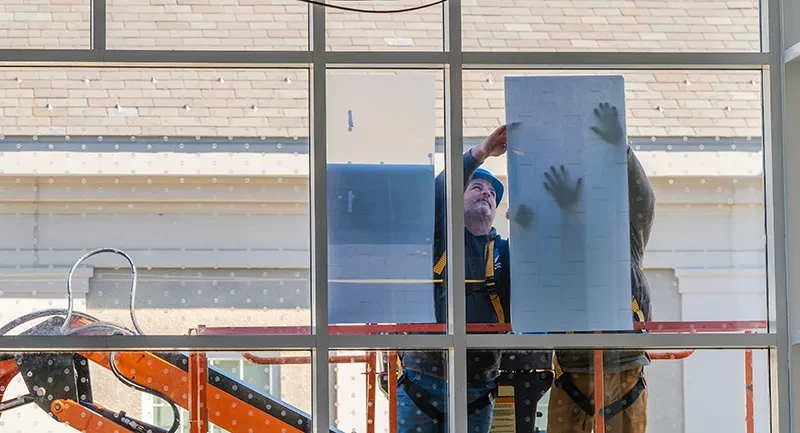
Facilities Services recently installed the bird-friendly decals on the second-floor windows of Schaffer Library, a hotspot for bird collisions on campus.
Assisted by funds from Facilities Services, the first phase of their project involved applying the decals to the first-floor windows around the Integrated Science and Engineering Complex (ISEC) bridge and walkway, near the pollinator garden. That area is the largest hotspot for bird-window collisions on campus. The decals promise to reduce the collision risk by up to 95 percent.
Corridore and Fuentes also applied for and were awarded a $10,000 Audubon in Action grant from the National Audubon Society. Those funds helped cover the recent installation of the decals on the second-floor windows of Schaffer Library, another key hotspot for bird collisions.
The students plan to use the remaining funds from the grant to install informational signage at both the pollinator garden and the library windows to raise awareness of the issue, how the decals can make the College safer for birds without interrupting the aesthetic integrity of the buildings, and how locals can help. The signs will include QR codes to a community reporting form that enables passersby to notify when they have discovered a collision with the windows on campus.
“I chose to come to Union for biology because of the amazing research opportunities they offer and the close connections with staff and faculty,” said Corridore, from Columbus, Ohio. “To me, this project really encapsulates those core values.”
For Fuentes, a biology major from Houston, the opportunity to get involved began after she met Perez in her first year at Union.
"I met Daniela in the AOP office and we quickly hit it off with shared interests in biology and environmental science," said Fuentes. "She told me how excited she was to do her thesis with Dr. (Jennifer) Bishop, and her passion for the project was contagious to me. While conducting her thesis, she would show me many photos of the bird imprints left from window collisions and her data was absolutely staggering. It really inspired me to pursue this project with Maya."
Bird collisions are not unique to Union’s campus. It is estimated that over a billion birds die each year worldwide due to collisions with glass windows, according to the U.S. Fish and Wildlife Service.
Investigations of avian mortality at campus windows has been ongoing for more than 13 years, starting with Kathleen LoGiudice, biology professor emeritus and her thesis student, Stacie Schwartz ’13. They developed a campus transect to identify windows with high avian mortality. Along the transect, Stacie recorded signs of bird collisions and any carcasses found.
Jennifer Bishop, senior lecturer of biological sciences, continued the mortality study with Josephine Landry ’22 and later Daniela Aleman Perez. She now works with Corridore and Fuentes. Another of her thesis students, Olivia Dell’Oso ’27, is collecting post-treatment data on avian mortality at windows following treatment with UV-tinted decals.
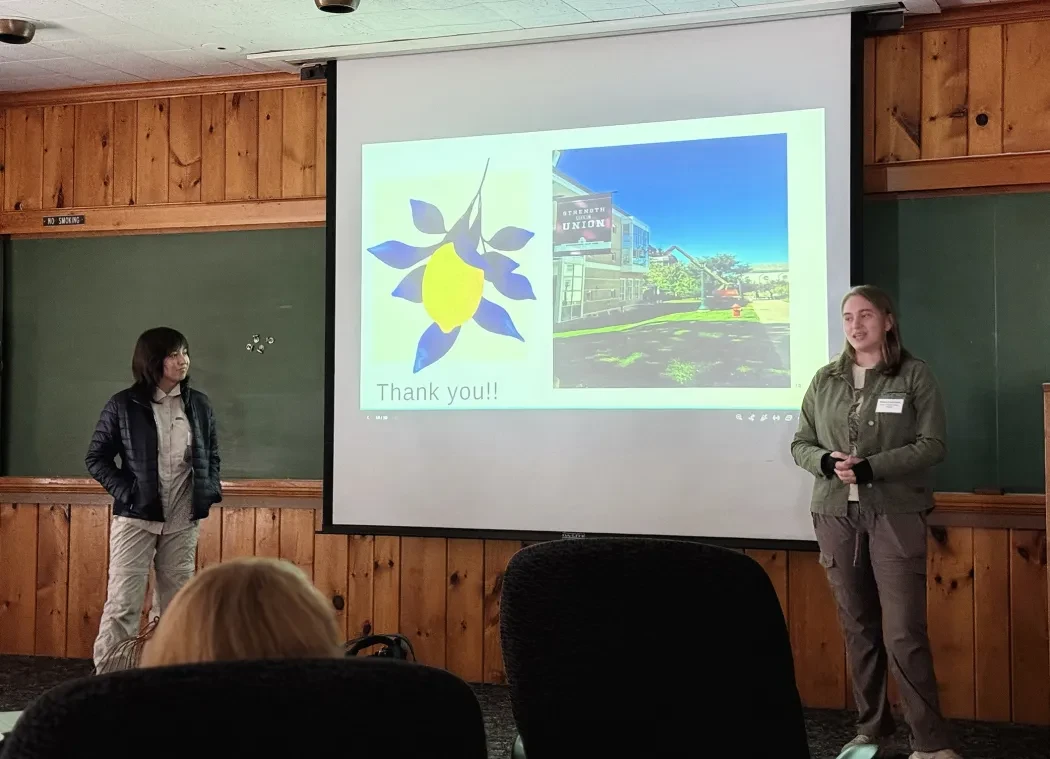
Maryann Fuentes '27 and Maya Corridore '27 Fuentes were invited to discuss their project at the Audubon Council NY/CT retreat in Hamilton, N.Y.
“Maya and Maryann have really impressed me with their dedication to make campus a safer place for birds,” said Bishop. “Not only did they recognize the problem, but they initiated all of the work to make these windows safe. I have never met two undergraduates as committed to the welfare of our campus birds as these two students.”
Corridore and Fuentes were recently invited to discuss their project at the Audubon Council NY/CT retreat in Hamilton, N.Y.
“Our project demonstrates how not only can you perform very interesting research as an undergrad, like Daniela did, but your work actually has direct, real-world impacts,” said Corridore. “I'm currently preparing applications to Ph.D. programs, but this project showcases that you don't need a doctorate to make a difference. Even as undergrads, students can do more than just acquire great skills for a future career. They can actually build initiatives that improve the world around them, something that will last beyond their years at Union.”