Calder Baker ’29 was sorting through material in Special Collections when he discovered an old student scrapbook. Belonging to Frederick Richards, Class of 1888, the weathered book contained what one would expect for chronicling a student’s time on campus: menus, newspaper clippings and information related to his fraternity.
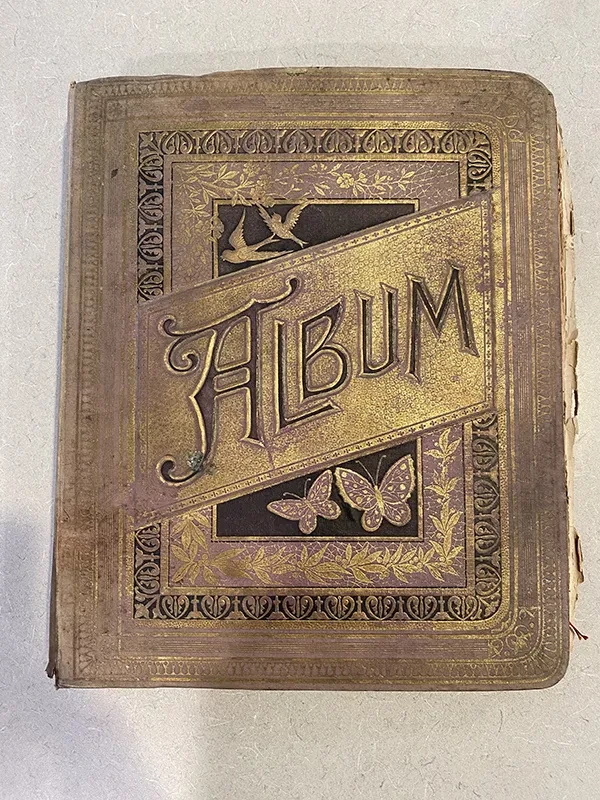
A scrapbook that belonged to Frederick Richards, Class of 1888.
Placed prominently at the front of the book, however, were mementos of a long-dead tradition: the burial/cremation of textbooks. This included special programs for the “Burial of Algebra,” or the “Burial of Mechanics.” Most striking, though, were the tintypes, or photographs on a thin sheet of metal, of participants in weird costumes.
“We wanted to learn more about why the students were dressed like that,” said Baker, a history and classics double major from Portland, Ore. “The inside of the scrapbook gives us a good answer.”
Staging mock funerals for textbooks to mark the end of a term was a popular tradition for many schools in the 19th century. Union students jumped on the bandwagon in 1854 and continued the tradition for most of the century.
The celebratory ritual, guided by a program to mark the occasion, often featured a grand marshal, a drum major or brass band, and a poet who would lead a dirge or chant.
The tradition began at Union with sophomores after final exams at midnight on July 18, 1854, according to Wayne Somers’ authoritative “Encyclopedia of Union College History.” Organizers wrote clever dirges based on “Massa’s in the Cold, Cold Ground,” and on the tune a classmate later used for the “Ode to Old Union.”
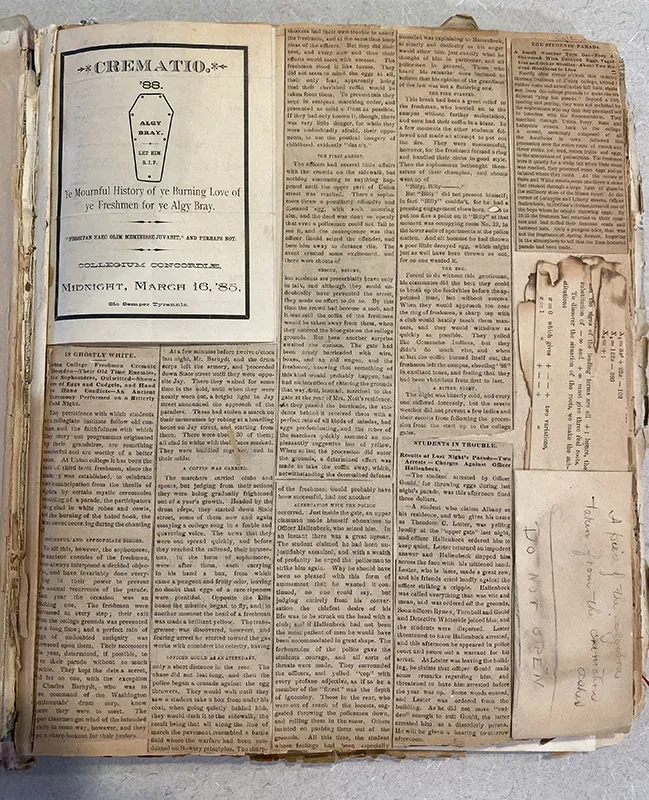
The first page of a scrapbook belonging to Frederick Richards, Class of 1888, has mementos of a mock funeral he participated in as a freshman.
They marched by torchlight up Union Street, to what is now Rugby Field, sang a dirge over Whatley’s logic textbook and placed the “corpse” on a burning tar barrel, according to Somers.
Jonathan Pearson, a professor and college treasurer, wrote in his diary that the barrel threw up “an immense volume of lurid flame illuminating the College and grounds for a great distance.”
As the ceremonies took root, College officials tried, with little success, to reign them in.
“In the pale fire, stands the sombre pyre. With the coffin on its breast, the time has come, our task is done, and we will have a rest!” began one farewell to an algebra textbook on Dec. 19, 1889.
The tradition evolved over the years, with the ceremonies becoming more elaborate and, in some cases, dangerous. Sponsorship also shifted, from the sophomore class to the junior class, and by 1879, to the freshman class. By then, sophomores, and later, local townsfolk, were encouraged to harass the procession, Somers wrote.
The fighting could be vicious, Somers noted. Some freshmen were severely cut when hit by large pieces of ice, and in 1885, a club-wielding freshman “laid open a town boy’s head.”
In addition to celebrating the completion of a course, the ceremonies also served as a way for freshmen to symbolically establish their right to full membership in the student body, according to Somers.
The tintypes found in Richards’ scrapbook show him and others in flowing white gowns. Richards is carrying a club, and his outfit is adorned with skull and crossbones, a typical symbol of farcical mystery. Another has some type of facial covering.
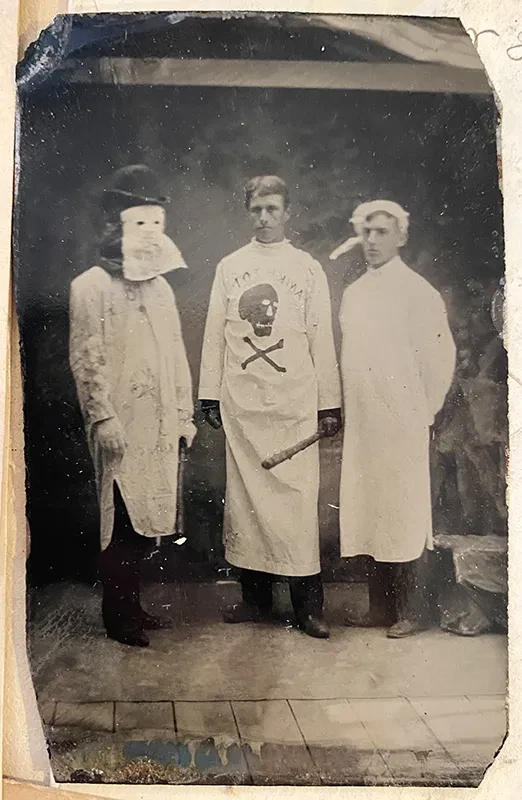
A tintype from the scrapbook of Fredrick Richards, Class of 1888, shows Richards, center, with two other students dressed for a mock funeral of a textbook.
“It looks bad,” said Baker, “until we learned the covering was used to protect themselves.”
Beginning in 1892, the celebrations scaled back in size and sponsorship, and by March 1897, quietly ended.
The Richards scrapbook is one of nearly 350 collections being reviewed by Baker and others to make them more accessible to the public. A noted historian, Richards served as secretary, treasurer and vice president of the New York State Historical Association. He died in February 1958. He was 92.
His student scrapbook has relevance today, said Joseph Lueck, outreach and reference archivist in Special Collections.
“It represents finding belonging,” Lueck said. “Students clearly put their hearts into this, particularly Frederick Richards, and viewed it as a true rite of passage to become part of the Union College community. I would challenge students to consider rituals and similar rites of passage that tie them to Union today and bring them feelings of community and belonging on our campus.”