Elsie Paxton '27, whose passion for helping Ukrainian children affected by the ongoing war with Russia, traveled to Washington, D.C. this week to continue her advocacy.
Paxton was invited to a panel discussion, “Ukraine's Humanitarian Response: Local Voices, Shared Perspectives," hosted by People in Need Ukraine at the US-Asia Institute.
The event brought together Ukrainian civil society and local organizations, U.S. policymakers, donors and international partners for a conversation about humanitarian needs and realities on the ground, the role of local responders, and how international partnerships can strengthen locally led humanitarian action and longer-term resilience.
Since arriving at Union, Paxton has been deeply involved in the plight of the Ukrainian children. As a first-year student, the mechanical engineering major (with a minor in English literature), joined a project led by Kristin A. Bidoshi, professor of Russian, to teach English to Ukrainian children.
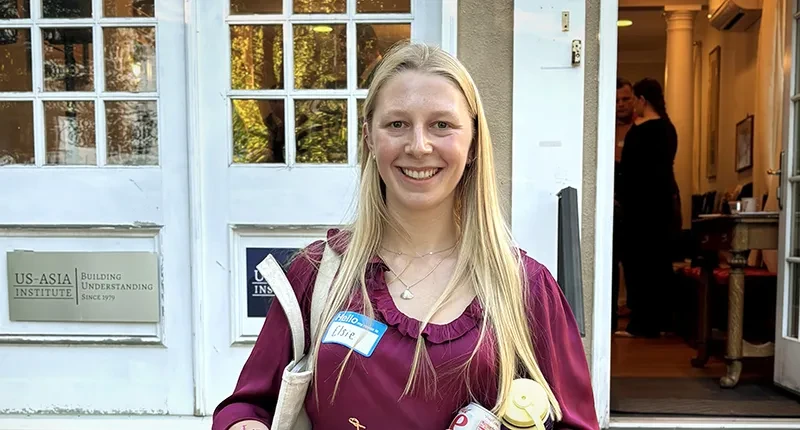
Elsie Paxton '27 outside a panel discussion on Ukraine's humanitarian response at the US-Asia Institute.in Washington, D.C.
The connections she made with her Ukrainian students inspired Paxton to create her own project which involves shipping 200 STEM kits overseas. The kits are packed with a small, solar-powered robot, notebooks, magnifying glasses and sunflower seeds, among the items.
Last spring, she won a Kathryn Wasserman Davis Projects for Peace award for her project, “Sunflowers and Science: Environmental STEM Education for Ukrainian Children.”
Her project led to her invite to Washington.
“I went to learn from people on the ground to understand how student projects like Sunflowers and Science can be of use to the people of Ukraine,” said Paxton, of Durham, N.H. “Winter is many communities' most urgent concern. The speakers expect attacks on energy infrastructure to continue, and rural communities are feeling the cold right now. In many villages only older residents remain and whole homes are heated by wood stoves. Sometimes these homes have not been repaired from bombings.”
Paxton said organizations described giving cash directly to families, along with fuel, camping stoves and chargers. Speakers also noted that aid often arrives late in the season when fuel costs are at a premium. She said several speakers argued for decentralizing the power grid which includes expanding sustainable infrastructure such as wind and solar power.
Women and veterans carry much of the burden. She said Leaders from Women in Tech Ukraine described the burden of supporting families while soldiers are away, and explained their mission to train women for technical jobs such as solar installation to address the shortage of skilled workers.
The speakers expect millions of veterans after the war will need a higher level of care while re-entering society, including emotional, physical and financial support. Children's education is another gap, the panel said. There are limited educational opportunities for children whose parents are working or serving in the military and social workers are stretched thin.
“Continued air raids drive children underground during the school day which disrupts learning,” Paxton said.
The opportunity to attend the panel should enhance Paxton’s project.
“I left with a better sense of what Ukrainian communities need and with new contacts at several of the organizations,” she said. “I hope to continue Sunflowers and Science in collaboration with partners who know what children need on the ground.
“My main takeaway is that the most useful thing outsiders can do is listen to the local leaders who know what their communities need and then support them accordingly. Hearing this directly was invaluable.”