Tibor Spitz was 12 when Nazi soldiers attacked Dolný Kubín, a tiny village in the mountains of northern Slovakia, at that time part of Czechoslovakia.
His family eventually fled into the forest, where they hid in an underground shelter.
“We hid for 200 days, and every day was the longest I have ever experienced,” Spitz recalled in an earlier interview. “As patrols on horseback and foot searched the forests, each day could have been our last. We lived like animals, instinctively, surviving from one minute to the next. We ate berries, we knew the mushrooms that we could eat, and sucked the water from the snow and ice to stay alive. It was just a biological level of survival. On the most basic level that you could imagine, nothing else mattered.”
In the spring of 1945 news of the end of the war reached the Spitz family, still in hiding.
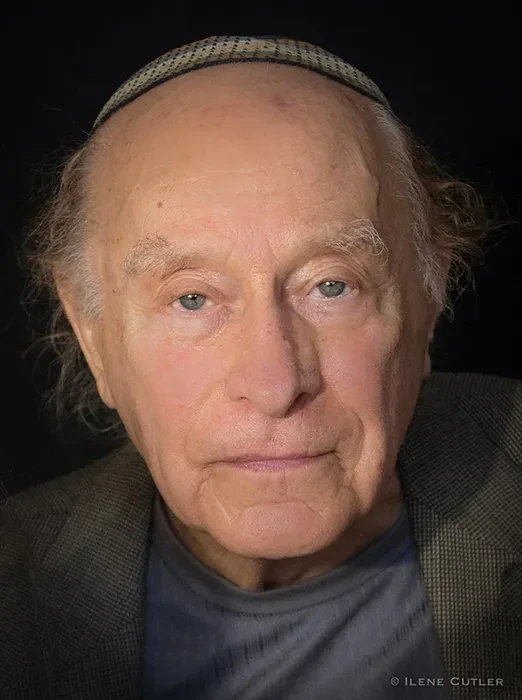
Tibor Spitz
“One day peasants came through the forests calling out, ‘If you are alive, come out.’” he said in the interview. “This was our liberation.”
Spitz will share his family’s harrowing story as a Holocaust survivor Monday, Nov. 9, at 5:30 p.m. in the Nott Memorial.
His talk, part of a Kristallnacht commemoration, is free and open to the public.
This year marks the 88th anniversary of Kristallnacht (the Night of Broken Glass), considered by many to be the start of the Holocaust. The pogrom refers to Nov. 9-10, 1938, when German Nazi paramilitary forces attacked Jewish individuals and their property in a widespread campaign of hatred and violence. Smashed glass was strewn on the streets from the windows of looted and vandalized shops and synagogues. World War II broke out a year later when Germany invaded Poland.
The Nazi genocide killed six million Jews across Nazi Germany-occupied Europe.
After the war, Spitz became a chemical engineer and later an artist, using his personal experiences and artwork to educate future generations about the Holocaust, antisemitism and the power of resilience and hope. Now 97, Spitz lives in Kingston, N.Y.
“Being the granddaughter of a Holocaust survivor, this is much more than an annual commemoration for me,” said Laiky Rubin, adviser to Chabad. “It is a privilege to hear Tibor Spitz share his story, especially as the number of survivors who can tell their stories firsthand grows smaller. At a time when antisemitism is rising, we have a responsibility to take what we learn from their experiences and put it into action: to speak up when we see hatred, to never stand by in silence, and to bring more kindness and humanity into the world.”
The program also features Stephen Berk, the Henry and Sally Schaffer Professor of Holocaust and Jewish Studies. He will provide historical and contemporary perspective on the significance of Kristallnacht.
Spitz’s talk is organized by Chabad at Union and co-sponsored by Alpha Epsilon Pi , Alpha Phi Omega, Chi Psi, Delta Phi Epsilon, the departments of History, Political Science and Visual Arts, Gamma Phi Beta, Hillel, the Office of Religious and Spiritual Life, the Religious Studies Program, Sigma Chi, Sigma Delta Tau, Sigma Phi and Theta Delta Chi.