In the summer of 1918, Harold M. Lewis was working in a Paris laboratory of the U.S. Signal Corps. A member of Union’s Class of 1916, Lewis was part of a talented team of radio engineers and technicians stationed in France during World War I.
Assigned to the newly-created Division of Research and Inspection, the team’s mission was to evaluate existing apparatus and propose changes, and to inspect equipment being manufactured in Europe for the American Expeditionary Force.
Working for a brilliant engineer, Captain Edwin Armstrong, Lewis and others on the team assisted Armstrong in developing what he called the superheterodyne receiver, which could help amplify signals from enemy airplanes, making them easier to detect.
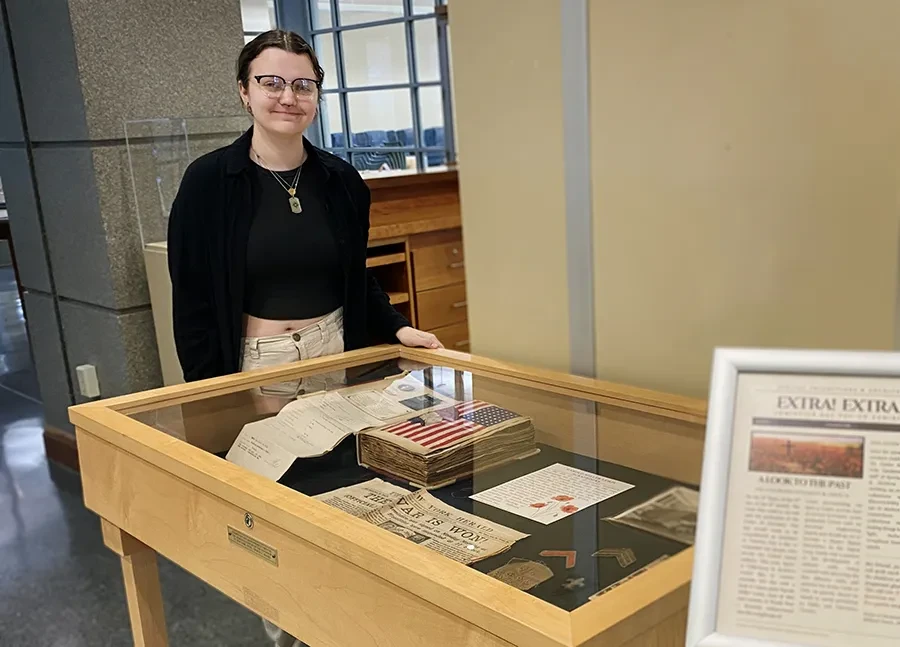
Addison Rosenko ’29, a student assistant for Special Collections and Archives, curated a new pop-up exhibit focusing on Harold M. Lewis, Class of 1916, and his service during World War I.
After experimental and developmental work was completed, it was time to figure out how to put the short-wave amplification into practical form.
“This work was placed in charge of Sergt. Lewis, assisted by Sergt. Houck,” according to a report of the Chief Signal Officer in 1919. “In preliminary tests the model gave several thousand times the amplification of the L-3, and the advantage could be increased by the addition of a two-stage audible frequency amplifier. Tests were completed, and it was ready for trial at the front at the time of the signing of the armistice.”
Lewis kept a meticulous notebook of Armstrong’s pioneering concept, which is kept at Columbia University’s archives. Today, the superheterodyne circuit is the basis for most radio, television and radar receivers.
Coinciding with Veterans Day, Lewis’s life story is part of a pop-up exhibit near Beuth Atrium in Schaffer Library.
Curated by Addison Rosenko ’29, a student assistant for Special Collections and Archives, the exhibit relies on one of two oversized scrapbooks from Lewis, which were recently rediscovered as part of an ongoing project to increase public access to 348 little-known collections.
One scrapbook is devoted to Lewis’s time overseas during the war, while the other chronicles his time at Union.
“Both scrapbooks are fascinating, but his World War I book is particularly of note, for the main reason that it exists at all,” said Rosenko, a history and classics double major from Exeter, Pa. “Veterans often do not recount their war stories to civilians and many want to completely forget it happened at all. So, the fact that we are able to look into a small but monumental moment of Lewis’s life is incredible.”
The exhibit features bold newspaper headlines, illuminating photos, Lewis’s patches from his military dress, and most solemnly, a note from Lewis requesting the location of graves for two of his fallen friends that was on the front inside cover of the scrapbook.
“It is a stark opener to remind the viewers—and Lewis himself—the horrors of war and the cost that comes with fighting in combat,” said Rosenko.
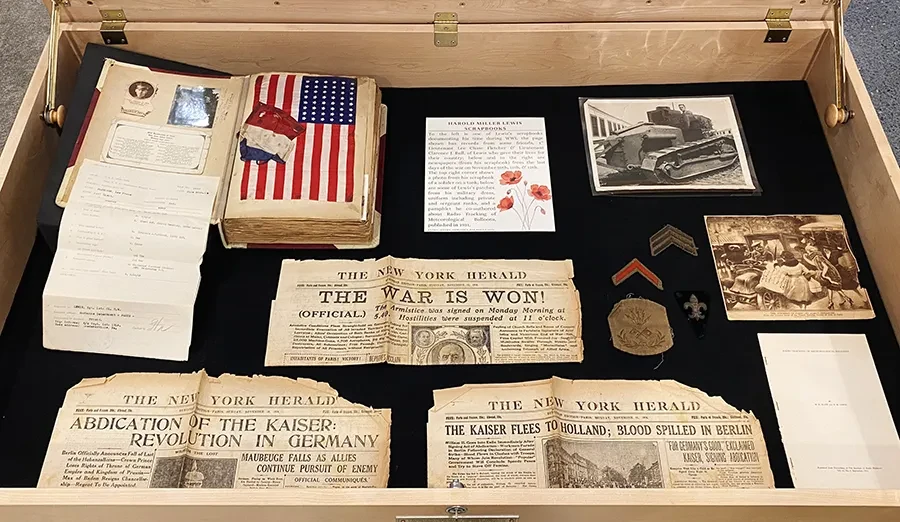
A new pop-up exhibit near Beuth Atrium in Schaffer Library celebrates the life of Harold M. Lewis, Class of 1916.
Lewis was born Jan. 12, 1893, in Geneva, N.Y., to Lucia and Samuel Lewis, a clothing merchant. An electrical engineering major, his Union scrapbook is filled with photos, stories, letters and vintage archival information, including report cards and his anthropometric tables, measuring everything from his height and weight to the length between his buttock and knee.
On Jan. 28, 1925, he married Mary Gertrude Tobin, in New York City. No records have been found to indicate whether the couple had any children.
After the war, he had a distinguished career at Hazeltine Corporation, an American defense electronics company. Information he submitted to the alumni office credited him with developing the first effective radio and antenna work for Army tanks. He held 56 patents related to radio and television circuits.
He died Oct. 15, 1978. He was 85. His obituary stated he was survived by two nieces and a nephew.
Lewis was among more than 1,200 Union men who served in World War I. The names of 26 Union men killed in that war are engraved on a wall in Memorial Chapel.
“I hope that people who view this exhibit would see the simple life of a man doing what he believed to be his duty to his country,” said Rosenko. “I hope they see a man who fought for their freedom and who lost friends along the way. I hope they see a man who gave both his body and his mind to the protection of his country. Because when I looked through both of his scrapbooks, I saw a young student just like me. One who had homework and classes and friends and romance and hardship and love and had no idea what the future would hold for him, but kept on living every day, one step at a time.”