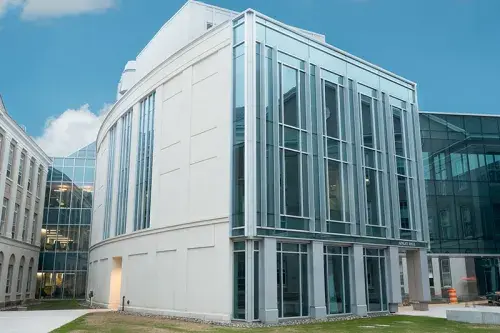
Physics and Astronomy Department
The following sample schedules indicate the approximate order of courses to complete a degree in Physics for a student beginning the major in his or her first year. As many Union students elect to spend a term abroad, we present two versions of the schedule, one for a student who is on campus for all four years, and the other for a student taking a term abroad in the Fall of junior year. Explanatory notes are provided after the schedules.
Sample Schedule without Term Abroad
| Year | Fall Term | Winter Term | Spring Term |
|---|---|---|---|
| First Year: |
|
|
|
| Second Year: |
|
|
|
| Third Year: |
|
|
|
| Fourth Year: |
|
|
|
Sample Schedule with Term Abroad
| Year | Fall Term | Winter Term | Spring Term |
|---|---|---|---|
| First Year: |
|
|
|
| Second Year: |
|
|
|
| Third Year: |
|
|
|
| Fourth Year: |
|
|
|
Notes: These schedules assume the maximum number of General Education courses, with no “double-counting” or transfers to meet requirements, The schedule with the term abroad assumes that classes taken on the term abroad count toward the World Languages (WOL) requirement. Five Writing Across the Curriculum (WAC) courses are required; physics courses that fulfill the WAC requirement are indicated. Often general education courses may fill more than one requirement; for example, a literature course might also count as a WAC.
Note that even under these conservative assumptions, it is possible to complete a strong Physics major with a number of free electives. These electives may easily be combined with General Education courses or other electives to allow a student to complete a second major or a minor.
The first-year schedule assumes that students will take Math 110 in the Fall of their freshman year. The Math department has several introductory tracks, depending on the level of preparation students have received in high school. Students who have taken Advanced Placement tests may be placed into Math 113, which combines Math 110 and Math 112 at an accelerated rate; students with exceptionally strong math backgrounds may start with Math 115. All of these variants are easily accommodated within the Physics curriculum.
Two classes are listed as “Science Electives.” Physics majors are required to take two other science or engineering classes numbered 100 or above, at least one of which must be from outside the physics and astronomy department. We encourage students to take these classes as early as possible, as they may lead students to pursue double majors or interdisciplinary majors.
Two classes are listed as “Math Electives.” We strongly recommend that students who may be interested in graduate study in physics take math courses beyond those required for the major. In particular, students would benefit from courses such as Math 127: Numerical Methods, Math 130: Ordinary Differential Equations, and Math 140: Applied Linear Algebra.