Community-based Learning Courses

Every term, a variety of departments offer courses built around principles of community-based learning: engaging with community partners, addressing a community-based topic, connecting curricular material with community-based activities, and structuring course assignments around reflection.

These courses are all part of the broad range of Experiential Learning opportunities at Union.

Courses

  • AAH-218 Social Impact of Art & Entrepreneurship

    Instructor: Lorraine Morales Cox, Associate Professor of Art History

    A study of the theory, and practice of culturally driven community development with a focus on urban renewal, social ecosystems, regenerative communities, equity and diversity. Through the study and analysis of case studies, field research and workshops, students will develop creative place making proposals that support and create sustainable and connected communities. Experiential team based learning collaborators will include community partners, organizations, businesses and mentors from the City of Schenectady. Students will see and experience first-hand the transformational impact of creative place making and gain skills for successful project management that also support the development of an entrepreneurial mindset. CC: HUM, WAC ISP: AMS

  • AMU-325 Music, Civic Engagement, and Sustainable Instruments

    Instructor: Jennifer Milioto Matsue, Professor of Music

    Music, Civic Engagement, and Sustainable Instruments is a service learning course that allows students to engage with the local Schenectady community by partnering with the Mont Pleasant Middle School 21st Century Afterschool Program; explore sustainable design, such as upcycling found objects into new sound producing instruments or related artistic objects; and collectively explore and expand your own ability to enact positive social change through your academic pursuits and beyond. CC: HUM, GCHF, GCAD, GSPE

  • ANT-210 Anthropology of Poverty

    Instructor: Jeff Witsoe, Associate Professor of Anthropology

    This course places students in internships in local organizations dealing with poverty for several hours each week. In class, we use this experience to reflect on larger debates about poverty in the US. Why has urban poverty remained so entrenched in the United States, even amidst the unprecedented economic expansion of the postwar period? This course will seek to answer this question by exploring the relationships between race, public institutions, economic change and inequality within American society. In doing so, the course will examine the theoretical and practical dimensions of anthropology’s engagement with poverty. We will begin by examining theoretical approaches for understanding the persistence of poverty in the United States, as well as the major policy frameworks that seek to reduce poverty. In addition, the course will cover anthropological critiques of these approaches and anthropological accounts of the everyday realities and struggles of poor people. CC: LCC, SOCS, WAC, WAC-R, JCHF, JSPE ISP: AMS
  • ECO-391 The Income Tax: Policy and Practice

    Instructor: Mary O'Keeffe, Adjunct Professor of Economics

    This course integrates theory and practice in addressing income tax policy issues. Students run a Volunteer Income Tax Assistance Site in the community at which income tax forms are filled out for low-income tax payers. Students undergo training and pass an IRS certification test. Students participate in all aspects of running the site, including publicity, electronic filing, and site management. Class sessions are used for training and for study of the economics literature on income tax policy issues, including the Earned Income Tax Credit, policy towards subsidization of child care, tax compliance issues, and tax incentives for saving. Prerequisite(s): ECO 241 , ECO 243 , ECO 339 and a minimum GPA of 2.9 CC: SOCS

  • ISC-203 Exploring Healthcare Through Community

    Instructor: Rhona Beaton, Assistant Director of Health Professions

    A field course combining supervised observation and/or community based learning experiences in various health care settings with the study of problems and means of health care delivery and the social determinants of health. Please see department for approval and application process. CC: WAC, JSPE ISP: STS

  • MTH-063 Mathematics of Sustainability

    Instructor: Jue Wang, Professor of Mathematics

    Sustainability addresses the idea of a global society founded on respect for nature, universal human rights, economic justice, and a culture or peace. It is of vital importance and will affect everyone. Mathematics is essential in identifying and analyzing the challenges. Through a sequence of sustainability and mathematical concepts, exercises, and projects, you will be brought along on this journey and confront global challenges to develop an understanding of the complex environmental, economic, and sociocultural interlinkages, and to empower yourself to become an active citizen. Note: Not open to students who have passed (or have AP credit for) a college calculus course. CC: QMR, GDQR ISP: STS

  • SOC-230 Sociology of the Black Community

    Instructor: Deidre Hill Butler, Professor of Sociology

    Sociology of the Black Community Course is a sociological exploration of Black social life and social structure. Through rigorous engagement with empirical literature, lectures, and popular media, students gain a critical understanding of race relations and community development. The course features an Experiential Learning module (requiring 8 hours of active participation) where students apply theory to direct observation. This component partners with the Kenney Center for Community Engagement and Outreach to connect with local agencies, including Girls Inc., the Hamilton Hill Arts Center, the NAACP, local school districts, and Boys and Girls Clubs, to analyze real-world challenges and community empowerment efforts. Prerequisite(s): SOC 100 , AFR 100 , LAS 101 or GSW 100 CC: LCC ISP: AFR, AMS

  • SPN-405 Lost (and found) in Translation

    Instructor: Maritza Osuna, Senior Lecturer of Spanish

    SPN 405 provides advanced students of Spanish with foundational knowledge on the field of Translation and Interpretation Studies. The course hones advanced language skills, broadens cultural knowledge, and sharpens critical thinking skills as it examines translation from an interdisciplinary perspective. Class work will include translation of literary work and real-life translation for non-governmental or not-for-profit organizations. CC: WAC, HUM, LCC ISP: GSWS

and many others!

Explore all Union College courses in the Academic Catalog.

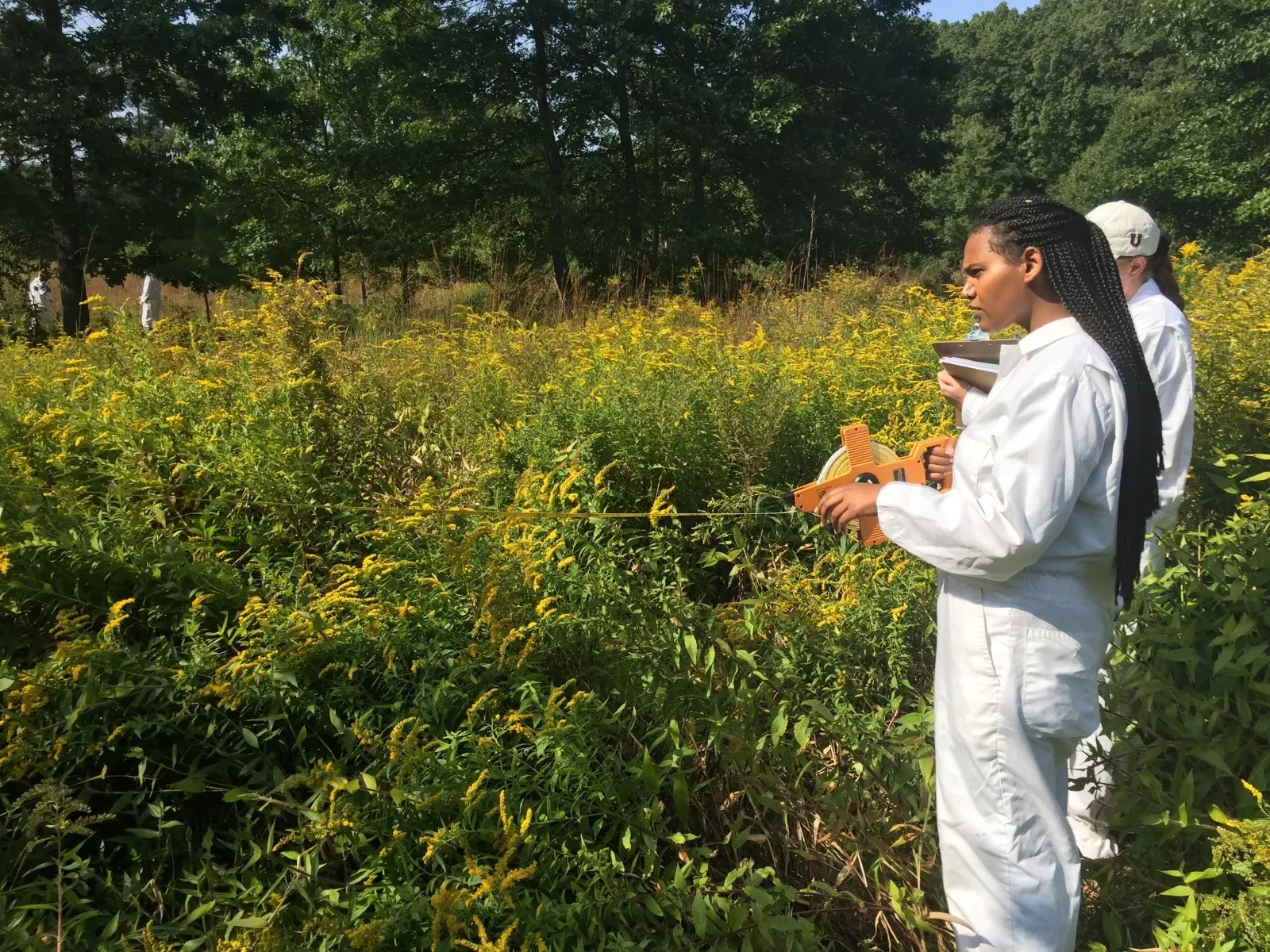
Students in Prof. Corbin's Plant Ecology class survey trees at the Albany Pine Bush Preserve

Students in Prof. Corbin's Plant Ecology class survey trees at the Albany Pine Bush Preserve