On Aug. 17, 1969, Hurricane Camille slammed into the Mississippi coast, leaving a path of death and destruction. The Category 5 storm, one of the strongest ever to make landfall in the U.S., killed more than 140 in the Gulf Coast region and leveled thousands of homes and buildings.
Disaster assistance was slow to arrive and criticism over the response helped lead to the 1970 Disaster Relief Act, which made permanent the expansion of a number of federal disaster assistance programs that had been pioneered in limited form in the late 1960s.
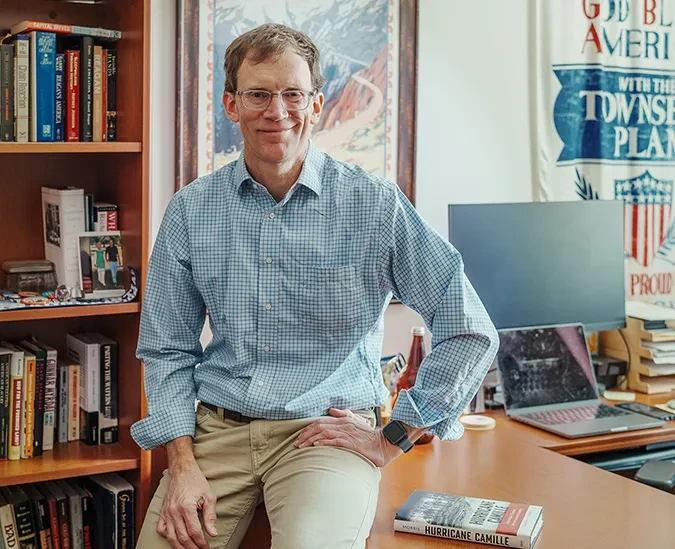
Andrew Morris, professor of history
The federal law also widened the scope of federal assistance to individual disaster victims, moving beyond the long-standing federal role in reconstruction of public facilities.
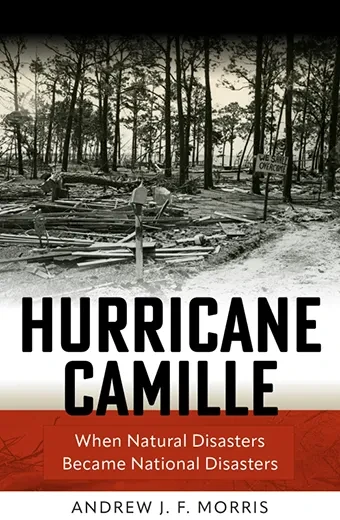
The devastating storm and the transformation of American disaster relief policy is detailed in a new book by Andrew Morris, “Hurricane Camille: When Natural Disasters Became National Disasters.”
Morris, a professor of history and chair of the department, is an expert on the history of disaster relief. He has been quoted in major media outlets, including the New York Times, Washington Post and NPR.
He was awarded a prestigious fellowship from the National Endowment for the Humanities to work on the book.
Morris joined Union in 2003.
Why choose a 57-year-old hurricane as a topic for a book?
I’ve always been interested in the history of how Americans have taken care of (or not taken care of) each other in times of need — and what kind of institutions and policies they created to do so. With the increasing significance of disasters in our lives in the 21st century, it felt like it would be useful to go back and look at how this played out with disasters in earlier periods.
I also thought that writing about disasters and disaster relief might be something that a broader audience might be interested in. I originally was going to write a book that focused on a series of big disasters in the mid-20th century, with Hurricane Camille as a chapter in that book. But as I got into the story of Camille, I found it so interesting that I decided it really could stand on its own as the subject of the book — and it would lend itself to a more narrative structure, which I found really appealing.
What did your research entail?
A lot of travel to archives across the country. While some aspects of my research were made possible by digitized material — for instance, the daily newspapers on the Mississippi Gulf Coast, where the storm’s damage was the worst, and in Jackson, Miss., both of which have been scanned and made available through online collections — some of the most important material is on paper in places where I have to look at them in person. For this project, I hit archives all the way from Maine to Washington, D.C. to Indiana, and even California. I’ve traveled to Mississippi repeatedly over the past decade that I’ve been working on this.
What do you hope readers learn from the book?
For one, learning how is it that people came to expect the federal government to play a major role in relief and rebuilding after big disasters. It didn’t use to be the case a century or so ago when states, localities and the American Red Cross were the more significant actors, and it’s an interesting story about how ideas about the government across the 20th century. Another is that in the 1960s and 1970s, where the book is focused, there weren’t the sorts of sharp partisan divides over disaster relief that have emerged in the past 15 years or so — there was broad bipartisan support for these policies, even in an era where there were sharp divides in other areas of policy.
Is there something you learned during your research that you were unaware of before?
There’s a lot I didn’t know about the Mississippi Gulf Coast. I grew up in the Northeast and had never traveled down there until I started work on this project. It’s a fascinating, beautiful area, and it’s very different from what I knew about other parts of the state.
Since President Donald Trump returned to office, FEMA has been marked by agency firings, canceled grant programs and Trump’s threats to disband an agency that provides billions of dollars in disaster aid to states every year. Does FEMA have a future with Trump in office?
It’s hard to say — there’s been a lot of changes and disruption at the federal level in the past year or so that would have been hard to predict. But at the end of the day most states get hit with disasters at some point in time, and lots of the states that are most disaster prone — hurricanes and flooding in particular — are represented by Republicans, who have constituents who will demand assistance after disasters. The federal government remains one of the biggest sources of aid, much of which flows through programs administered by FEMA. I would anticipate, out of sheer self-interest if nothing else, that many of those programs will remain, even if FEMA itself ends up looking different.
This interview has been edited and condensed for clarity.