Elizabeth Bias ’26 spent the last three years working in a campus lab on the development of a vaccine for Lyme disease, the most common vector-borne disease in the U.S.
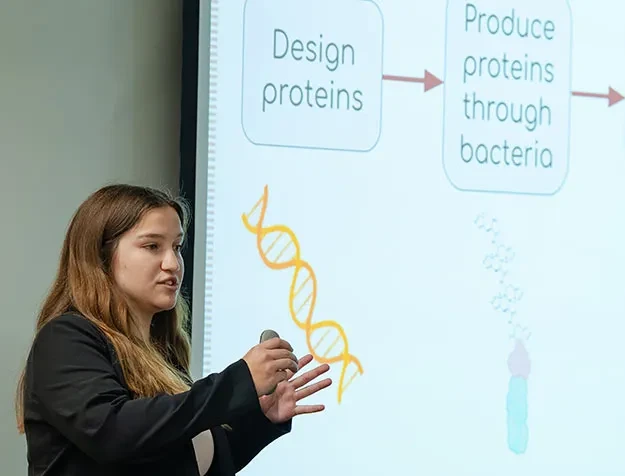
Elizabeth Bias ’26 was among the more than 500 students who took part in the 36th annual Steinmetz Symposium Friday. She spent the last three years working in a campus lab on the development of a vaccine for Lyme disease, the most common vector-borne disease in the U.S.
Mentored by Stephanie Curley, the Mary H. '80 and Richard K. Templeton '80 Assistant Professor of Biomedical Engineering, Bias’s work sits at the intersection of biomedical engineering and public health. It involves engineering small biological particles to display pieces of Lyme disease-causing bacteria in a way that can safely train the immune system to recognize and respond to an infection.
Her goal is to create a more reliable and long-lasting form of protection compared to current prevention methods.
“As tick habitats expand with climate change, Lyme disease cases continue to rise, revealing the limitations of current prevention strategies that rely on reducing humans’ exposure to ticks,” said Bias, a biomedical engineering major from Orlando, Fla. “This research instead takes a proactive approach by focusing on building immunity, offering a more consistent solution. I am excited to share this engineering-driven approach to improving human health.”
Bias was among the more than 500 students who took part in the 36th annual Steinmetz Symposium Friday.
Overseen by Matt Anderson, director of undergraduate research and associate professor of computer science, the symposium showcases the type of hands-on, faculty-mentored research that is a staple of the Union experience. This included 190 oral presentations and 118 poster presentations. Also, more than 200 students were involved in dance performances, two musical concerts and an art exhibit.
Following tradition, classes were canceled for the pleasant spring day to allow faculty, staff, students and visiting family to shuffle between various academic buildings to sample projects in all fields – the arts, humanities, social sciences, sciences and engineering.
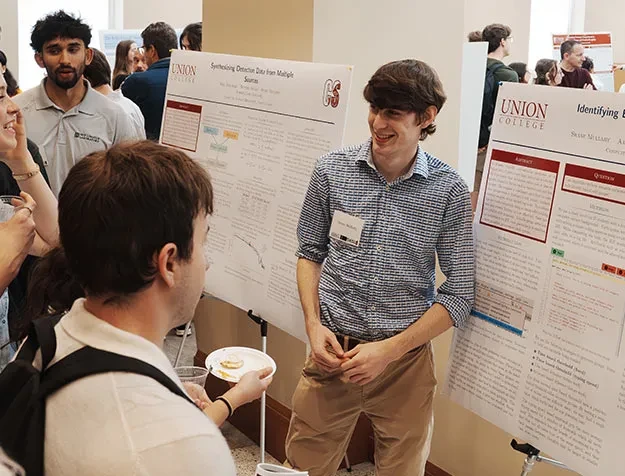
More than 500 students took part in the 36th annual Steinmetz Symposium Friday. This included 190 oral presentations and 118 poster presentations. Also, more than 200 students were involved in dance performances, two musical concerts and an art exhibit.
In a morning session, Theo Goldman ’26 shared the economic and environmental benefits of efficient showerheads. A double major in economics and environmental science, Goldman explored how simple efficiency changes could save building operators money on their water and heating bills. Working with Mark Moreau in Facilities, Goldman tested a half-dozen showerheads to measure the flow rate. He also created the website freefixtures.com, where building owners can enter basic inputs, and see visualizations of financial metrics as well as the environmental impact.
“Environmentally friendly policies and actions are often perceived as at odds with each other,” said Goldman, from Boston, Mass. “A main focus of combating human-caused climate change is a shift towards resource conservation. Using water, electricity and materials all cost money, making it in the best interest of companies, and the environment to use less. The average family of four could pay for its Netflix subscription every month simply from the water and electricity cost savings generated from using a low-flow showerhead.”
Goldman gave a second presentation in the afternoon on his experience last fall as part of the Klemm Fellow International Internships. Goldman traveled to Koh Tao in Thailand to study marine conservation. He participated in bleaching surveys, debris cleanup, microplastic analysis and the construction of artificial reef structures.
Alex Roginski’26 is completing their senior thesis on architectural acoustics. A physics major with minors in French and Japanese, Roginski’s Steinmetz project compared eight performance spaces on campus, including the Nott Memorial, Memorial Chapel, Old Chapel, Emerson Auditorium, Reamer Auditorium, Yulman Theater, Studio A and TARDIS,(The Acoustic, Research, Design and Industrial Studio) in Wold.
As a taiko player, they have struggled with performing in certain spaces. They discussed how some spaces are predisposed to certain styles of music, particularly classical. Working with Chad Orzel, the R. Gordon Gould Associate Professor of Physics and Astronomy and chair of the department, and Christopher Chandler, associate professor of music, Roginski qualitatively analyzed the dimensions, qualities, materials and unique features of each space.
“Memorial Chapel is fantastic for orchestra and choir performances, but the taiko ensemble---Zakuro-Daiko---struggles to perform there due to the long reverberation time and echoes,” said Roginski, from Saratoga Springs, N.Y. “Emerson Auditorium, on the other hand, is a versatile space that just about any music style can succeed in.”
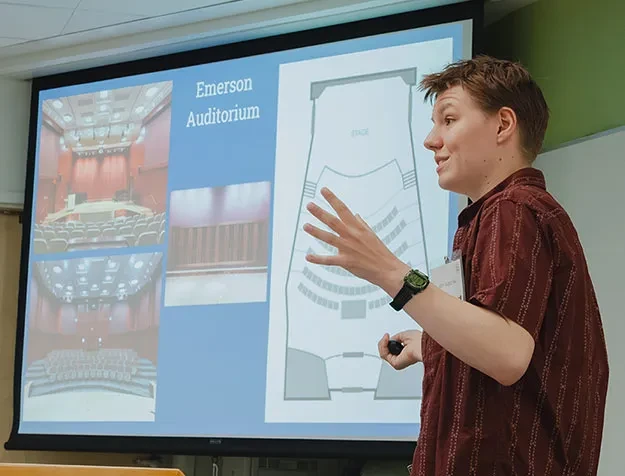
Alex Roginski ’26 is completing their senior thesis on architectural acoustics. A physics major with minors in French and Japanese, Roginski’s Steinmetz project compared eight performance spaces on campus, including the Nott Memorial, Memorial Chapel, Old Chapel, Emerson Auditorium, Reamer Auditorium, Yulman Theater, Studio A and TARDIS,(The Acoustic, Research, Design and Industrial Studio) in Wold.
They offered possible solutions for how each space could be improved to welcome more musical styles.
“The Nott Memorial could have acoustic panels installed to cut down on the muddy echoes,” they said. “TARDIS has a large curtain that, when pulled shut, greatly improves the clapbacks that occur when standing close to the wall. However, most students don't realize that drawing the curtain would improve sound quality”
To emphasize interdisciplinary connections, one change for this year’s symposium was to hold a single interdisciplinary poster session in Schaffer Library. Among the presenters was Dani Brown ’26, an economics and Africana Studies ID major from Chicago, Ill.
Brown’s research examined how highway construction in her hometown shaped long-term housing values in Black neighborhoods and contributed to patterns of racial wealth inequality. Many highways were intentionally routed through predominantly Black communities during the mid-20th century, causing displacement, neighborhood division and disinvestment.
“From a young age, I noticed the stark differences between communities on different sides of the city and often questioned why certain neighborhoods faced more disinvestment, environmental harm and economic struggle than others,” said Brown.
“I began to understand that these conditions were not accidental, but deeply connected to historical policy decisions and urban planning. This project became an opportunity for me to investigate the history behind the spaces I grew up around and better understand how infrastructure, race, and wealth intersect to shape everyday life in Black communities.”
Also at Steinmetz, the Templeton Institute hosted “The Powers of Interdisciplinary Undergraduate Research: Textual Technologies” in Olin auditorium. It was moderated by Vauhini Vara, an award-winning author and journalist for The Atlantic, The Wall Street Journal and the New Yorker.
The Chamber Music Showcase featured live pieces or digital recordings performed by students and directed by resident ethnomusicologist and department chair Jennifer Milioto Matsue in Emerson Auditorium in the Taylor Music Center.
One of the highlights of the symposium is the Lothridge Festival of Dance in the Nott Memorial and this year was no exception. Seventy performers representing six campus dance clubs and teams entertained an overflow audience, including Bhangra, Dance Team, JAIVE Afrovibes, hip hop, K-pop and Latin Dance.
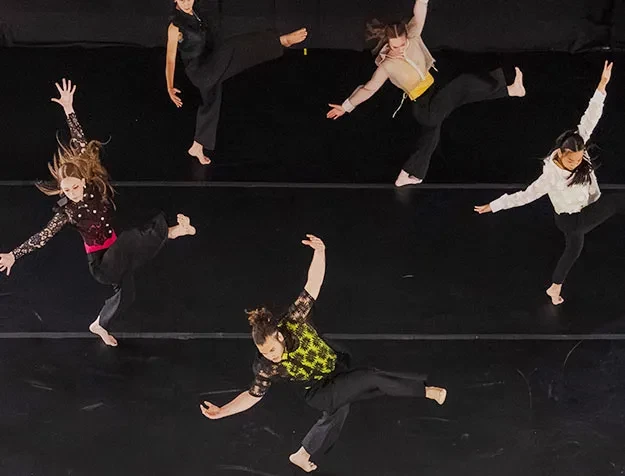
One of the highlights of the symposium is the Lothridge Festival of Dance in the Nott Memorial. Seventy performers representing six campus dance clubs and teams entertained an overflow audience, including Bhangra, Dance Team, JAIVE Afrovibes, hip hop, K-pop and Latin Dance.
The Steinmetz Symposium Student Art Exhibition in the Crowell and West Galleries in the Feigenbaum Center for Visual Arts featured some 270 works by 76 students. Mediums include digital art, drawing, painting, photography, printmaking and sculpture.
The day wrapped up with the spring concert featuring the Union College Schola Cantorum, Union College Choir and Union College and Community Orchestra in Memorial Chapel.
On Saturday, a concert featuring the Union College Jazz Ensemble, led by Professor Tim Olsen, was held in Emerson Auditorium in the Taylor Music Center.
The Steinmetz Symposium is named for Charles Proteus Steinmetz (1865-1923), who taught electrical engineering and applied physics at Union. A chief consulting engineer for the General Electric Company, he was widely regarded as America’s leading electrical engineer.
For a complete list of presentations, visit the Steinmetz website.
The symposium coincides with Prize Day, which was held Saturday afternoon in Memorial Chapel. More than 100 awards were presented to honor students for achievement in academics, leadership and community service.
Dani Brown ’26 and Mai Tran ’26 captured the top two awards.
Brown received the Frank Bailey (1885) Prize. It is awarded annually to the senior who has rendered the greatest service to the College in any field. It is considered the most prestigious student prize at Union.
Tran received the Josephine Daggett Prize. It is presented annually to a senior for conduct and character.