- R. Booth*, J. Pei, J. Shaffer, C. D. Keating*. Dynamic and catalytic multiphase coacervates. Biomacromolecules 2026, 27 (8), 5090–5104.
- J. Lee, F. Pir Cakmak, R. Booth, C. D. Keating*. Hybrid protocells based on coacervate-templated fatty acid vesicles combine improved membrane stability with functional interior protocytoplasm. Small 2024, 20 (52), 2406671.
- R. Booth, I. Insua, S. Ahmed, A. Rioboo, J. Montenegro*. Supramolecular fibrillation of peptide amphiphiles induces environmental responses in aqueous droplets. Nature Communications 2021, 12, 6421.
- R. Booth, Y. Qiao, M. Li, S. Mann*. Spatial positioning and chemical coupling in coacervate-in-proteinosome protocells. Angewandte Chemie International Edition 2019, 58 (27), 9120–9124.
- R. Booth, I. Insua, G. Bhak, J. Montenegro*. Self-assembled micro-fibres by oxime connection of linear peptide amphiphiles. Organic & Biomolecular Chemistry 2019, 17 (7), 1984–1991.
- N. Martin, J.-P. Douliez, Y. Qiao, R. Booth, M. Li, S. Mann*. Antagonistic chemical coupling in self-reconfigurable host-guest protocells. Nature Communications 2018, 9, 3652.
Y. Qiao, M. Li, R. Booth, S. Mann*. Predatory behaviour in synthetic protocell communities. Nature Chemistry 2017, 9 (2), 110–119.
* Corresponding author
Richard Booth
Areas of expertise
Origin of life, Protocells and artificial cells, Coacervates and biomolecular condensates
Research interests
I'm interested in how chemical systems communicate. Living cells constantly signal to one another, and my lab asks whether we can build simple artificial cells that do the same with one another and with their surroundings. Much of this comes down to compartments. Mixtures of peptides, RNA, and synthetic polymers can spontaneously assemble into dense, liquid-like droplets called coacervates, which concentrate some molecules while excluding others. We study what holds these droplets together and what controls the molecules moving in and out. A compartment that cannot exchange anything with its surroundings cannot signal. Underneath it all is a question about origins: how the earliest chemical systems first formed organized compartments, and how those compartments might then have communicated and organized into communities before modern cells evolved. Students in my group learn polymer synthesis, peptide chemistry, nucleic acid chemistry, and fluorescence microscopy while contributing directly to ongoing research.
Teaching interests
CHM 101 Introductory Chemistry I & Lab
CHM 382L Biochemistry: Structure and Catalysis Lab
Publications
-
Publications
Academic credentials
B.Sc., University of Leeds; M.Sc., University of York; Ph.D., University of Bristol
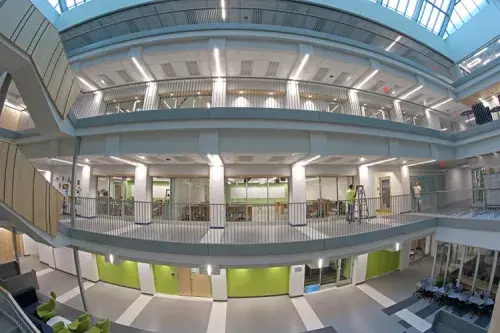
Integrated Science and Engineering Complex (ISEC)
View in Google Maps